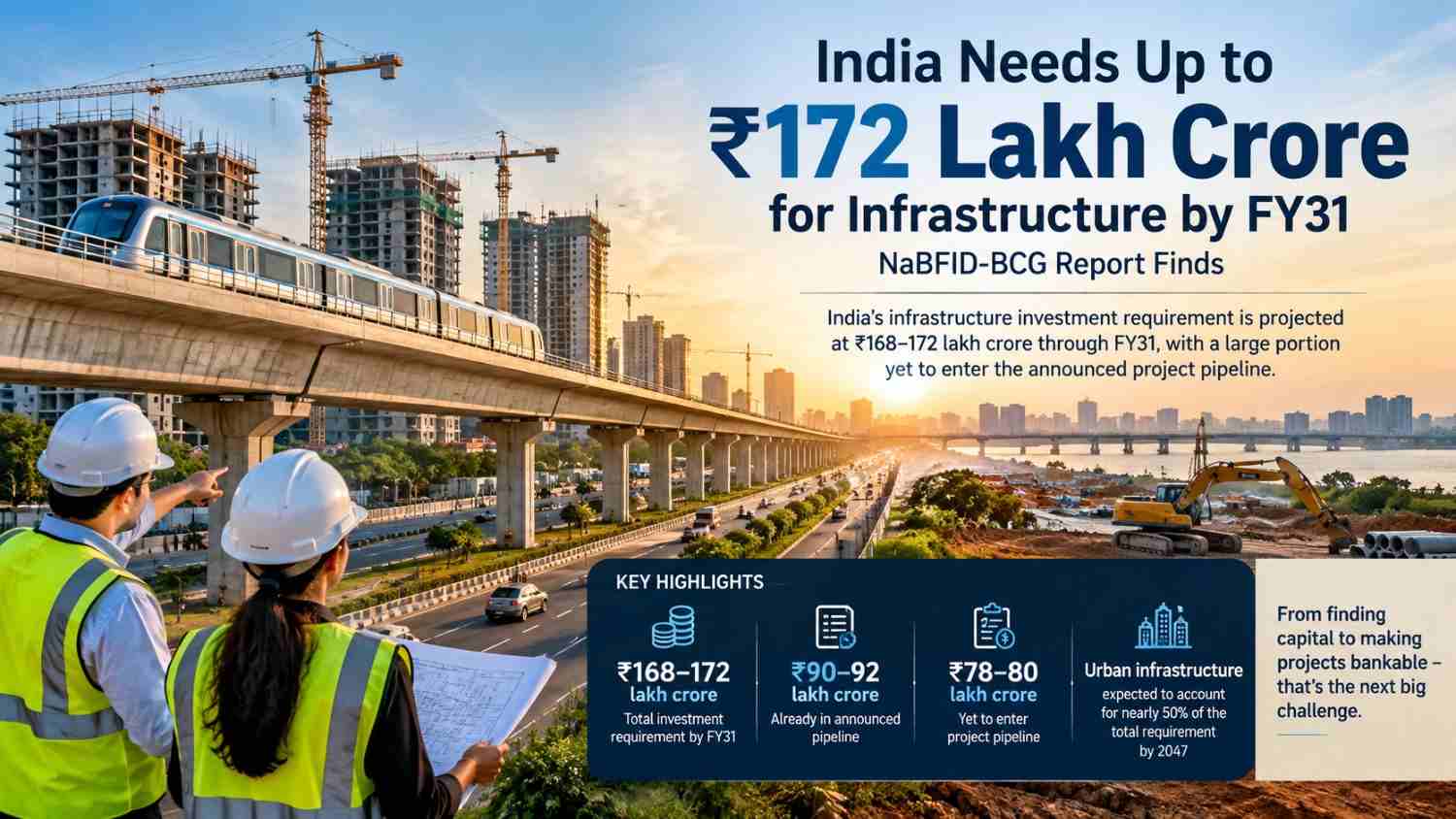
India is expected to require between ₹168 lakh crore and ₹172 lakh crore in infrastructure investment through FY31, highlighting the scale of financing needed to support the country’s continued economic expansion, according to a joint report by the National Bank for Financing Infrastructure and Development (NaBFID) and Boston Consulting Group (BCG).
The report, titled “Channelizing Domestic and Global Capital for Infrastructure Financing,” said that around ₹90–92 lakh crore of the requirement is currently part of the announced project pipeline. However, another ₹78–80 lakh crore has yet to translate into an announced pipeline, creating a significant challenge for project preparation and financing.
Financing Gap Remains a Key Challenge
Of the overall infrastructure requirement through FY31, approximately ₹38–40 lakh crore has already been financed, while around ₹31–32 lakh crore is awaiting financial closure. Another ₹21–22 lakh crore is classified as stalled, according to the report.
The report also estimates that India could require ₹680–770 lakh crore of infrastructure investment through 2047, underlining the importance of developing long-term financing mechanisms.
Urban Infrastructure to Drive Future Demand
A major portion of India's future infrastructure demand is expected to come from urban infrastructure. The report estimates that urban infrastructure could account for nearly half of the country's infrastructure requirement through 2047.
Projects involving metro systems, water supply, irrigation and new railway lines are expected to deliver significant economic and social benefits. However, many such projects do not have standalone financial viability or established revenue models, making them more dependent on public-sector support.
Greater Role for Private Capital
NaBFID said government capital expenditure will need to be complemented by private-sector investment to meet the country's infrastructure ambitions.
The report highlighted stronger project preparation, commercial viability, better risk allocation and capital recycling as important factors in attracting domestic and international investors.
It also identified financing mechanisms such as Infrastructure Investment Trusts (InvITs), Alternative Investment Funds (AIFs), private credit and partial credit enhancement as potential channels for expanding infrastructure financing.
Annual Financing Gap of ₹2–3 Lakh Crore
According to the report, existing capital pools could cover most of India's FY26–FY31 infrastructure demand under current conditions. However, an estimated ₹2–3 lakh crore annual financing gap remains.
Domestic institutional investors are estimated to have around ₹2–3 lakh crore of undeployed capacity within existing regulatory limits. Mobilising this capital could help bridge part of the financing gap, provided projects become more commercially viable and investment risks are better structured.
With greenfield projects making up around 80–85% of the forward pipeline, India will also need stronger mechanisms to manage land, construction, financing and ramp-up risks.
The report ultimately points to a shift in India's infrastructure financing challenge—from simply finding capital to making projects bankable and creating reliable revenue models that can attract long-term domestic and global investment.
"The decisions we make today will shape the world for generations to come."