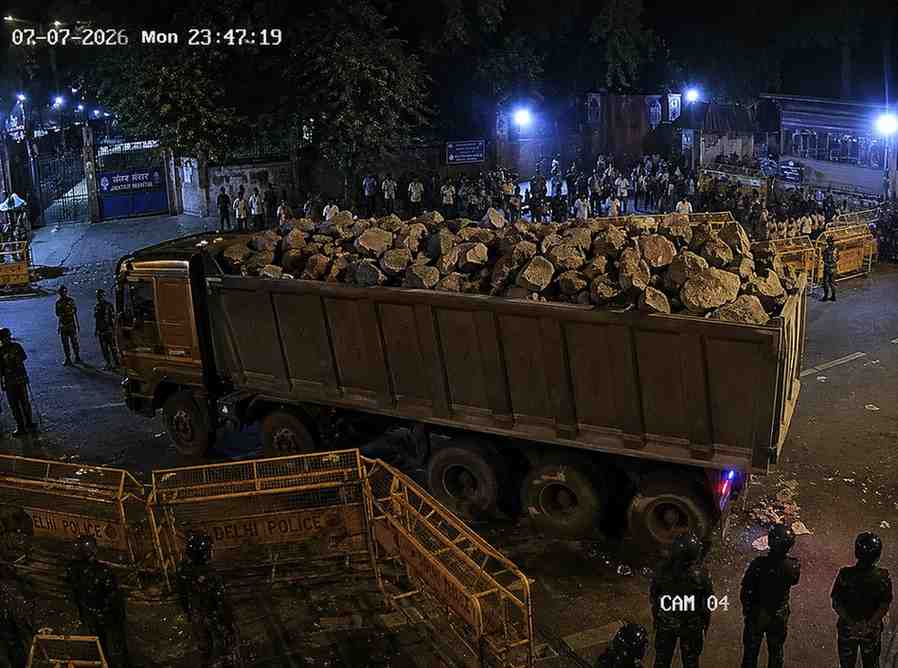
In the dead of night, when most of the capital sleeps and only the determined remain at Jantar Mantar, another truck loaded with stones has been reported near the protest site. Spotted around 12:30 am on 24 July, the vehicle appeared under the same heavy security blanket that has already choked the area with barricades, internet restrictions and delivery blackouts. The timing is too convenient to ignore.
This is not the first time stones have arrived in bulk at the protest ground. Earlier in the agitation, videos circulated of dumpers and trucks filled with stones and debris positioned close to the site. Protest organisers publicly asked the same question then that citizens are asking now: under the gaze of hundreds of police personnel, multi-layered security and continuous surveillance, how does a truck full of potential weapons simply materialise? Who ordered it? Who allowed it to reach the heart of the demonstration?
The pattern is becoming familiar. A peaceful demand for accountability over examination paper leaks that have ruined thousands of young lives is repeatedly met with the sudden appearance of material that can later be used to brand the protest violent. Police then release selective CCTV clips of stone-pelting. The narrative shifts from systemic failure in the education system to “law and order.” The Education Minister stays secure in his post. The students remain under siege.
The government that claims the future of youth as its highest priority has so far offered fast-track courts and strong statements. What it has not offered is an explanation for the repeated appearance of stone-laden vehicles in a high-security zone. Nor has it explained why basic supplies and communication are restricted while such trucks seem to move freely. When delivery apps are blocked and metro stations closed, the selective efficiency of the system becomes impossible to miss.
Students and their supporters have repeatedly alleged that the stones are not theirs. They point to the impossibility of bringing heavy loads past multiple police cordons without official knowledge or facilitation. The state responds with more force, more FIRs, and more claims of vandalism. The result is a carefully managed spectacle in which the original demand — clean examinations, accountability for leaks, and resignation of those responsible — is buried under images of chaos.
A nation that allows trucks of stones to appear at the site of a student protest while blocking food and internet for the same students is not maintaining order. It is manufacturing the conditions for confrontation. The midnight sighting on 24 July is not an isolated accident. It is another chapter in a larger strategy that prioritises control over correction.
The youth at Jantar Mantar are still waiting for answers about paper leaks. Instead they keep receiving new questions about mysterious trucks. Until those trucks are properly investigated and the real culprits of examination fraud are held to account, every such spotting will only deepen the conviction that the system is not protecting the protest — it is preparing to discredit it.
"The decisions we make today will shape the world for generations to come."