Dalal Street spent Friday morning discovering that Thursday’s “green close” was a parlour trick. The Sensex had finished 10 September at 74,902.59 and the Nifty at 23,477.80 after a closing-auction squeeze on expiry that briefly printed a 1,000-point fantasy and then melted back to a 138-point win. Overnight, Brent pushed toward $110. By 9:15, the same indices were staring at a hole of roughly 700–740 Sensex points and a Nifty print under 23,250. More than ₹5 lakh crore was marked off BSE’s listed value in the first minutes. That is not a dip. That is a country being repriced by a commodity it still cannot live without.
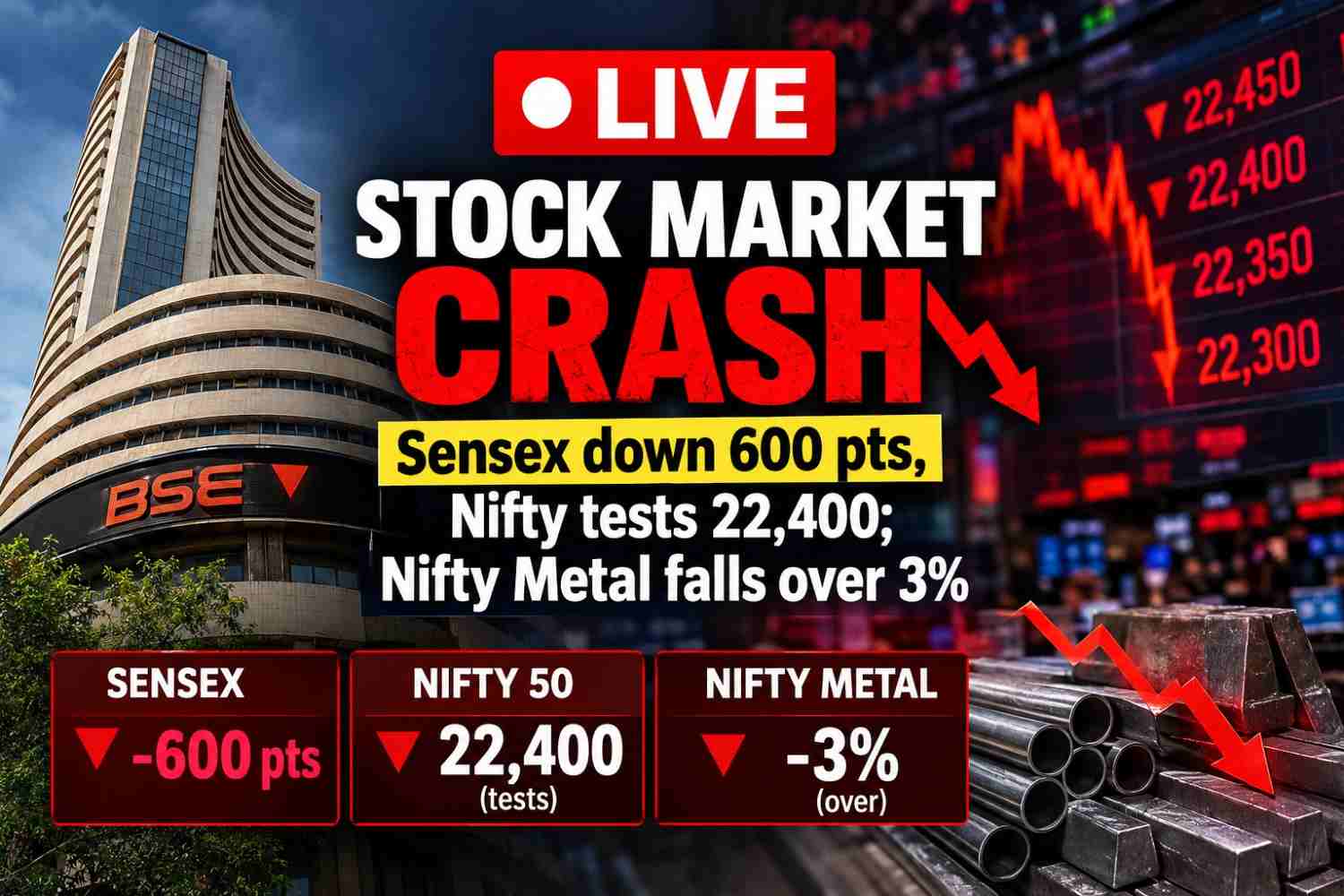
By early afternoon the headline writers had their softer line: Nifty back above 23,400, Sensex nearly flat versus Thursday. Around 1:13 pm the Nifty was still 143 points down at 23,334. Nearer 2:45 pm it had clawed to about 23,434, with the Sensex around 74,835 — a sliver under Thursday’s close. Fifteen of sixteen major sector boards stayed red. The only honest sentence on the tape was the sector one. Nifty Realty was down 3–4 percent at the worst, a sixth straight session of selling, Godrej Properties and Lodha off more than 6 percent. Nifty Metal lost about 2–3 percent, with Hindalco, Tata Steel, Vedanta, NALCO and Hindustan Copper taking the punch. IT flickered green because dollar revenues look prettier when the rupee is ugly. That is not strength. That is an export hedge wearing an index blazer.
Oil did this. Policy left the door open.
Brent printed a four-month high near $109.97 before easing toward $107. WTI crossed $100 for the first time since May. The weekly crude gain was running above 10 percent. The trigger is not a mystery: a West Asia war in its seventh month, shipping risk in the Red Sea and around the Strait of Hormuz, Iran-aligned Houthis taking Mocha, and Washington talking about hitting sites near Natanz. India imports the overwhelming bulk of the crude it burns. Every durable ten-dollar lift in Brent is an inflation tax, a current-account tax, a rupee tax and an earnings tax. Geojit’s V.K. Vijayakumar said a sustained $108-plus print would not be “insignificant” for GDP and corporate profits. He was being polite.
The same government that spent Friday morning at a BRICS Business Forum selling UPI as civilisational software runs an energy balance sheet that still genuflects to the Gulf. Years of “aatmanirbhar” speeches have not built a strategic petroleum cushion that can stare down a Hormuz scare. They have not weaned the fiscal math off the hope that crude will behave. When oil jumps, the choices are ugly and familiar: eat the inflation, cut the duty and blow the deficit, or pretend administered prices are a policy. Markets chose the first reading before lunch.
Yields did the rest. Realty is the confession.
The U.S. 10-year yield pressed 4.97 percent, a whisker from 5 percent, the highest since late 2023. The 30-year tagged 5.38 percent, a level last seen in 2007. Indian gilts followed; the 10-year crossed 7 percent. Rate-hike odds for the next Federal Reserve meeting jumped. Realty is a duration asset dressed as brick. Higher yields raise home-loan EMIs, raise cap rates, raise the discount on every unsold tower. An index already down 8.6 percent across six sessions does not “correct.” It tells you the cheap-money housing boom the political class keeps citing as a development miracle was levered to a world that no longer exists. Godrej and Lodha are not collapsing because Indians stopped wanting flats. They are collapsing because the cost of wanting them just reset.
Metals got the other blade. Higher oil is freight and power. A stronger dollar is a lower dollar price for copper, aluminium and steel. Soft demand signals from manufacturing hubs close the trap. Hindalco as a Nifty laggard is the tell: this is not a single stock story. It is a cycle being told it has no cheap energy and no easy money left.
The rupee had already slipped to the mid-95s against the dollar on Thursday and probed 95.79 in the panic window. The Reserve Bank’s shadow is the only bid anyone trusts. Foreign institutional investors sold a net ₹438 crore on 10 September; domestic institutions bought ₹1,026 crore. That pattern — foreigners leaving, mutual funds catching the knife with household SIPs — is now the operating system of this market. It is also a political convenience. As long as domestic flows paper the exit, the government can call every bounce “resilience” and every crash “global cues.” Global cues did arrive. The vulnerability is homemade: oil intensity, a thin rupee, an IPO calendar that has ten issues open and is draining secondary-market cash, and a Friday fear index (India VIX) jumping more than 6 percent through 12.5.
Thursday’s close deserves a footnote in any honest tape. The auction session manufactured a green print after a red day. Retail saw “Nifty above 23,400” and slept. Friday opened on the actual price of oil. If you need a metaphor for official India in 2026, use that: a last-minute auction, a victory tweet, and a morning that invoices the country in dollars.
A Nifty reclaim of 23,400 into the last hour is a gift to copy desks, not a clean bill. Immediate support that bulls were defending at 23,300 was kissed and abandoned before noon. A hold above 23,400–23,450 only matters if crude stops marching and the 10-year in Washington fails to clear 5 percent. If Hormuz risk stays bid, the next Indian conversation is not about UPI corridors at Bharat Mandapam. It is about diesel, airline margins (IndiGo was already a 3 percent casualty), cement costs, and whether the central bank is defending the rupee or the bond market, because it will not get to defend both for free.
Metal and realty plunging about 2 percent and more while the headline index flatlines is the market’s editorial. The index is a museum of large weights. The street is a list of businesses that need cheap oil and cheap money. India is short both today. No summit speech changes the barrel.
"The decisions we make today will shape the world for generations to come."