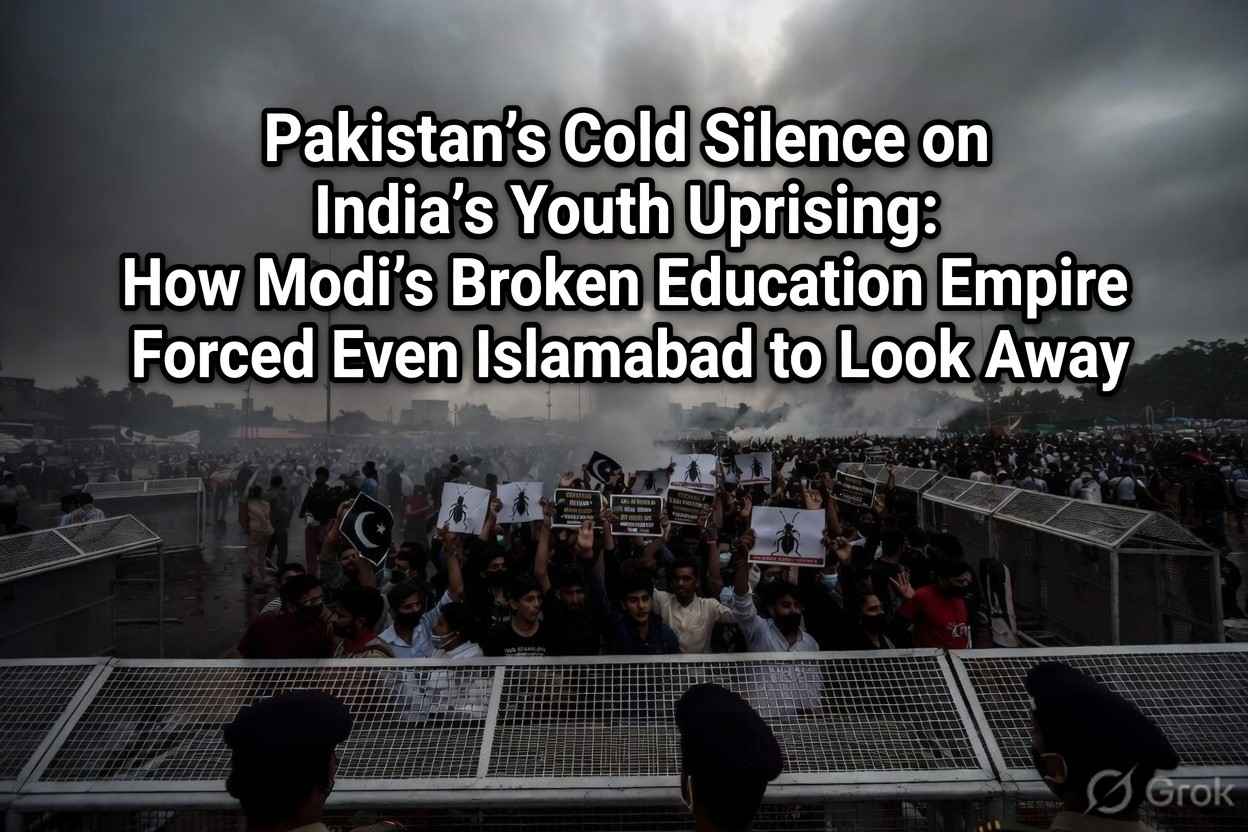
Pakistan’s foreign office was asked a direct question on Thursday about the ongoing Cockroach Janta Party protests rocking New Delhi — the same agitation that has now stretched into its second month, with students demanding the resignation of Union Education Minister Dharmendra Pradhan over the repeated NEET paper leaks and the larger rot in India’s examination system. The reply was short, clinical, and deliberately distant: “This is an internal matter of India. We do not offer comments on such matters.”
Spokesperson Tahir Andrabi delivered the line during the weekly media briefing. No moral lecture. No human-rights lecture. No attempt to weaponise the images of lathi charges, tear gas, and injured students that have flooded social media since the 20 July “Sansad Chalo” march. Just a clean diplomatic shrug.
That shrug is more damning than any statement of solidarity could ever be. For decades Pakistan has seized every opportunity to internationalise India’s internal problems — Kashmir, farmer protests, citizenship laws. Yet when tens of thousands of Indian students, many of them from the very demographic the ruling party claims to champion, take to the streets against a government that has spectacularly failed to protect the integrity of national examinations, Islamabad chooses silence. The reason is simple: even Pakistan can see that this particular fire was lit inside the house.
The Cockroach Janta Party did not emerge from any foreign conspiracy. It was born in May 2026 when a casual courtroom remark by the Chief Justice of India comparing certain unemployed youth to “cockroaches” collided with the public fury over the NEET-UG paper leak. What began as online satire under the hashtag #MainBhiCockroach rapidly became a physical occupation of Jantar Mantar. By mid-July the protest had drawn climate activist Sonam Wangchuk into an indefinite hunger strike, forced the government into multiple abortive outreach attempts, and culminated in the 20 July march toward Parliament that left both protesters and policemen injured.
The government’s response has followed a familiar pattern: first denial, then offers of talks at the convenience of the ruling party, then force when the students refuse to be managed. Fast-track courts for paper-leak cases were announced by the Prime Minister only after the agitation refused to die. The Education Minister remains in office. The structural failures that allow question papers to be sold in the open market remain unaddressed. Students who have lost years of preparation and, in some tragic cases, their lives to the chaos continue to sit under open sky in the capital while the system that failed them lectures them on law and order.
Pakistan’s refusal to comment is not restraint born of principle. It is recognition that the crisis is so thoroughly homemade that even a hostile neighbour finds no traction in it. The images of baton-wielding police against unarmed students, the videos of women allegedly manhandled, the Supreme Court’s dismissive “don’t waste our time” response to a plea on police excess — these are not the products of any external hand. They are the natural outcome of a governance model that treats examination integrity as an administrative inconvenience and public anger as a law-and-order problem to be dispersed rather than resolved.
The deeper damage is generational. A country that once promised its youth that hard work and competitive exams would open doors is now watching that covenant collapse under the weight of leaks, coaching-mafia influence, and political refusal to accept ministerial responsibility. The CJP protest is not merely about one minister’s resignation. It is the visible symptom of a system that has stopped delivering fairness at the most basic level of social mobility.
When even Pakistan — a state that has never missed an opportunity to highlight India’s domestic turmoil — decides the matter is too internal to touch, the message is clear. The crisis is not manufactured abroad. It is manufactured at home, by those who hold power and refuse to be held accountable. The students at Jantar Mantar are not asking for foreign sympathy. They are demanding that their own government stop treating the future of an entire generation as collateral damage in the politics of permanent power.
That demand continues. And the silence from across the border only makes the failure louder.
"The decisions we make today will shape the world for generations to come."