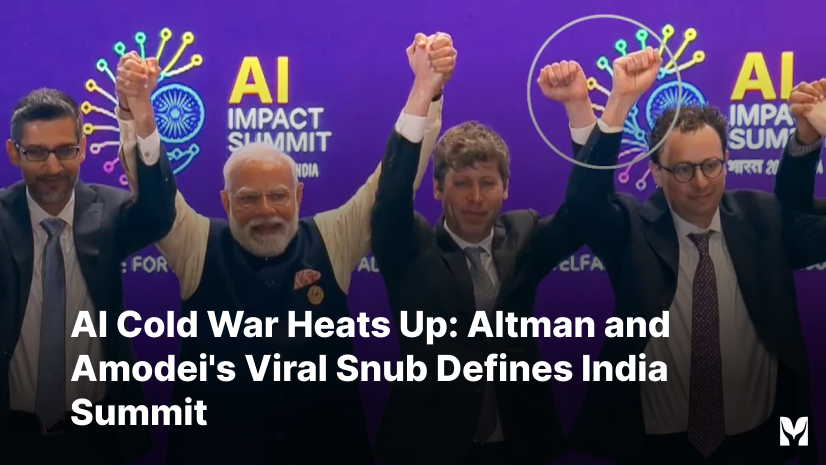
New Delhi, India – February 19, 2026 – The India AI Impact Summit, intended as a beacon of global AI collaboration, today became the unintended stage for a dramatic display of the industry’s escalating "AI Cold War." In a moment that has already gone viral, OpenAI CEO Sam Altman and Anthropic CEO Dario Amodei pointedly refused to hold hands during a group photo with Indian Prime Minister Narendra Modi, opting instead for raised, separate fists. The subtle snub, instantly dubbed "the handshake heard 'round the world," underscored a deep ideological chasm now defining the race for Artificial General Intelligence (AGI).
The awkward encounter, which took place mere hours after both companies released competing flagship coding agents—OpenAI's GPT-5.3 Codex and Anthropic's Claude 4.6 Opus—illuminates the fierce rivalry brewing between the two AI powerhouses. Their tension stems from a philosophical divide: Altman championing "aggressive scaling" and rapid deployment, while Amodei advocates for "safety-first" and "Constitutional AI." This fundamental disagreement exploded into public view during the recent Super Bowl LIX, when Anthropic aired ads perceived to mock OpenAI's move into ad-supported AI, leading to a fiery social media retort from Altman.
Beyond the personal drama, the summit delivered substantial news for the global tech landscape. Prime Minister Modi unveiled the ambitious M.A.N.A.V. (Human) Vision, a new global framework for ethical AI governance. MANAV, an acronym for Moral, Accountable, National Sovereignty, Authenticity, and Value-based AI, aims to create a "Glass Box, Not a Black Box" approach to AI development and deployment. Crucially, it calls for mandatory "authenticity labels" on all digital content—a direct response to the growing threat of deepfakes and misinformation.
India also solidified its position as a major player in the AI race with staggering investment commitments. Reliance, under Mukesh Ambani, pledged an astounding ₹10 lakh crore (approximately $120 billion USD) over the next seven years to build out India's AI infrastructure. In a significant partnership, the Tata Group confirmed a strategic collaboration with OpenAI, aiming to accelerate AI innovation within India and globally. These private sector investments are bolstered by the government's IndiaAI Mission, which has already onboarded over 38,000 GPUs to provide crucial compute access for burgeoning startups and researchers.
As the summit concludes, the world watches to see if the "AI Cold War" between Altman and Amodei will escalate further, or if the global push for ethical AI, epitomized by India's MANAV Vision, can bridge the divides. One thing is clear: the future of AI will not only be shaped by groundbreaking technology but also by the personalities and philosophies of the titans who wield it.
"The decisions we make today will shape the world for generations to come."