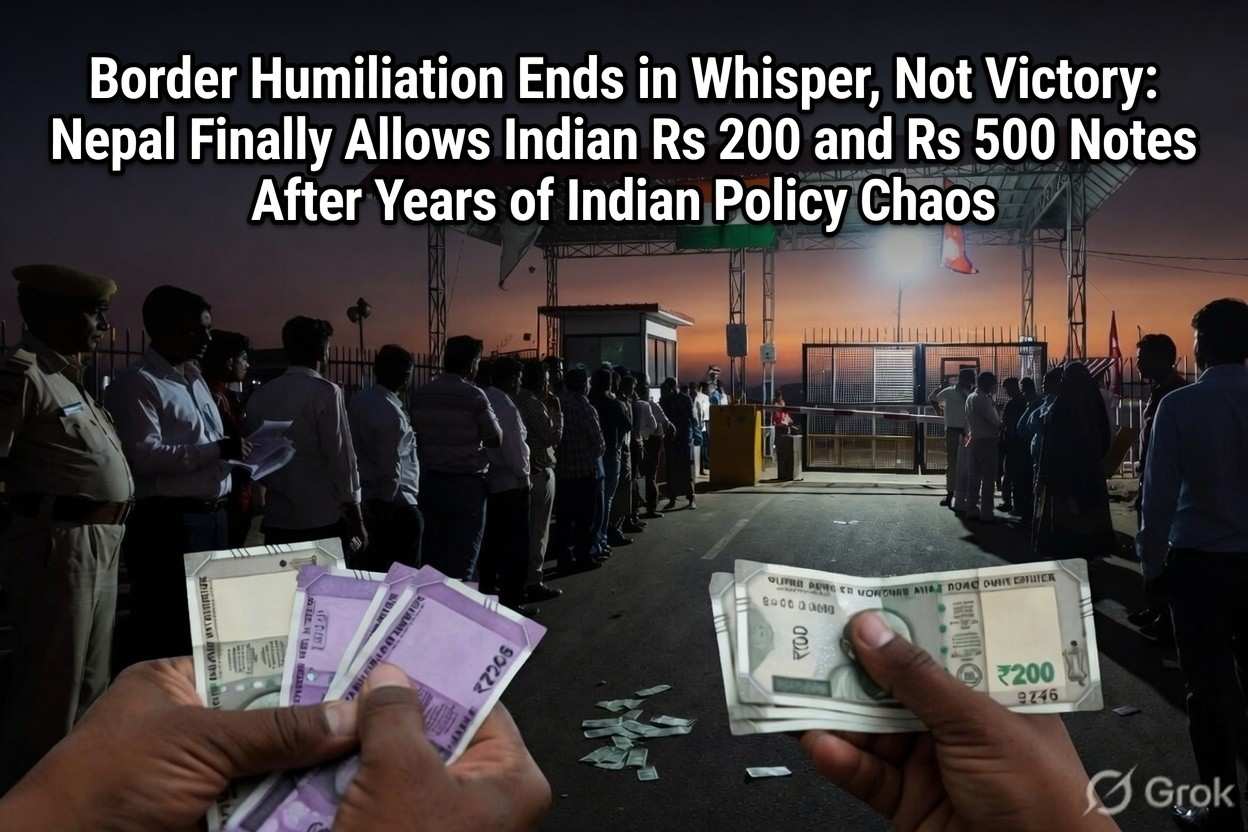
Nepal’s central bank has finally issued a clarifying notice allowing Indian and Nepali citizens to carry, bring in, or take out redesigned Indian Rs 200 and Rs 500 notes up to a strict limit of Rs 25,000 per person. Only notes issued after 9 November 2016 are permitted. The older Rs 500 and Rs 1,000 notes from before India’s chaotic demonetisation remain completely banned. Nepali citizens cannot bring Indian currency from any third country and can only carry it back to India, not elsewhere.
On paper this looks like a routine administrative correction. In reality it is a quiet admission of how badly India’s 2016 currency experiment continues to disrupt the lives of ordinary people living along one of the world’s most open borders.
For nearly a decade after India suddenly withdrew high-value notes, Nepal was forced to impose restrictions to protect its own financial system from the flood of invalidated Indian currency. Small traders, daily wage workers, students, pilgrims and families who cross the border for basic needs were left scrambling with only Rs 100 notes or forced into informal, often exploitative exchange channels. The latest Nepal Rastra Bank notice, which builds on a cabinet decision notified earlier and reconfirmed this week, simply formalises a limited concession that should have been sorted years ago.
The Rs 25,000 ceiling is not generosity. It is damage control. India remains Nepal’s largest trading partner and the biggest source of tourists and remittances. Thousands of Nepali citizens work, study or seek medical care in India every month. Yet the currency rules governing this intense people-to-people movement were left in a state of deliberate ambiguity for years. The result was predictable: harassment at checkpoints, loss of time and money for the poorest, and a thriving grey market that benefited neither country.
What this episode really exposes is the long shadow of a policy decision taken in Delhi without adequate consideration of its regional consequences. When high-denomination notes were abruptly withdrawn in 2016, Nepal had no choice but to protect itself. The subsequent years of restricted circulation of even the new Rs 200 and Rs 500 notes were not Nepal’s failure. They were the direct outcome of an Indian move that prioritised domestic political theatre over practical economic coordination with a neighbour that shares an open border and deep economic interdependence.
Even now the relief is partial and hedged with conditions. Older notes remain forbidden. The limit is modest. Nepali nationals face extra restrictions on the direction of flow. These are not the markers of a mature, confident bilateral economic relationship. They are the markers of a system that still treats the daily friction of ordinary border communities as an afterthought.
While official statements speak of facilitation for tourists and traders, the deeper truth is less flattering. India’s currency policy has repeatedly forced smaller neighbours to adapt to sudden shocks rather than being designed with regional realities in mind. The people who suffer most are not the policymakers in either capital. They are the shopkeepers in border bazaars, the students carrying fees, the patients seeking treatment, and the workers sending home modest savings.
A genuine partnership would have resolved the circulation of legitimate post-2016 notes years earlier through quiet, technical coordination. Instead, the issue dragged on until Nepal’s central bank had to issue yet another clarifying notice. That delay is not a bureaucratic oversight. It is a symptom of a larger pattern in which grand announcements in Delhi are rarely followed by the hard, unglamorous work of making rules work for ordinary citizens on both sides of the border.
The latest easing of rules will bring some practical relief. It will not erase the years of inconvenience, uncertainty and quiet resentment that preceded it. Until currency and trade arrangements between India and Nepal are treated as matters of mutual economic security rather than residual afterthoughts of domestic policy experiments, the border will continue to function as a zone of managed friction rather than seamless opportunity.
"The decisions we make today will shape the world for generations to come."