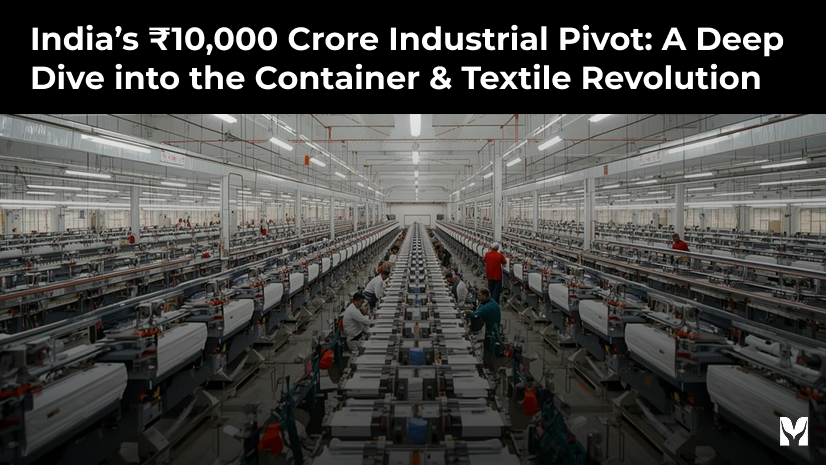
The Big Picture: Re-coding the Indian Export Engine
The Indian government has just unveiled a massive ₹10,000 crore blueprint aimed at two critical, yet often overlooked, pillars of the economy: Container Manufacturing and Textiles. By integrating these two sectors, the policy moves beyond simple subsidies; it is attempting to solve the "Logistics-Product" paradox that has long throttled Indian exports.
For decades, India has been a textile giant hampered by expensive freight and outdated machinery. This new initiative is designed to modernize the hardware (machinery), the software (skills), and the delivery system (containers) in one unified "system upgrade."
1. The Fiber-to-Fashion Stack: A Multi-Layered Approach
The new scheme isn't a monolith; it’s a modular program consisting of five distinct sub-parts designed to address specific "bottlenecks" in the value chain.
The Self-Reliance Protocol: National Fiber Scheme
India is aiming for total "stack sovereignty" in textiles. By focusing on everything from traditional silk and jute to high-tech man-made fibers, the National Fiber Scheme aims to decouple Indian manufacturing from volatile global supply chains.
Samar 2.0: Upgrading the Human Capital
In a world driven by automation, the textile sector remains labor-intensive. Samar 2.0 acts as a bridge between industry and academia, ensuring that the workforce isn't just "employed" but "skilled" for the era of technical textiles.
2. Competitive Logistics: Why Containers Matter
You cannot win the global trade war if you don't own the "boxes" your goods travel in. By allocating a portion of the ₹10,000 crore budget to indigenous container manufacturing, India is:
- Reducing dependency on global shipping cartels.
- Lowering the "Input-to-Export" cost ratio for SMEs.
- Ensuring that the "Make in India" label starts from the packaging itself.
3. The "Mega Park" Strategy: Scalability in Challenge Mode
The proposal to set up Mega Textile Parks via "Challenge Mode" is a game-changer. By making states compete for these hubs, the government ensures that only the most efficient ecosystems—those with the best power, water, and labor laws—get the funding.
The Focus? Technical Textiles. These aren't just clothes; they are high-margin industrial fabrics used in healthcare, automotive, and construction. This is where the "Alpha" (excess return) lies for the next decade.
4. Grassroots Integration: The Mahatma Gandhi Gram Swaraj Initiative
Modernization doesn't mean leaving the past behind. The integration of Khadi, Handlooms, and the One District One Product (ODOP) initiative ensures that rural artisans are plugged into the global API. By providing branding and market linkages, the government is turning local heritage into a global premium brand.
Investor Takeaway
This ₹10,000 crore outlay is a strategic bet on vertical integration. For the investor, the "Buy" signal isn't just in the garment exporters, but in the companies building the containers, the manufacturers of textile machinery, and the producers of technical fibers.
The "Execution" Risk: As with any large-scale deployment, the success of this scheme depends on the speed of implementation. However, the holistic nature of this plan—addressing everything from raw fiber to the shipping container—suggests that India is finally thinking like a global supply chain superpower.
"The decisions we make today will shape the world for generations to come."