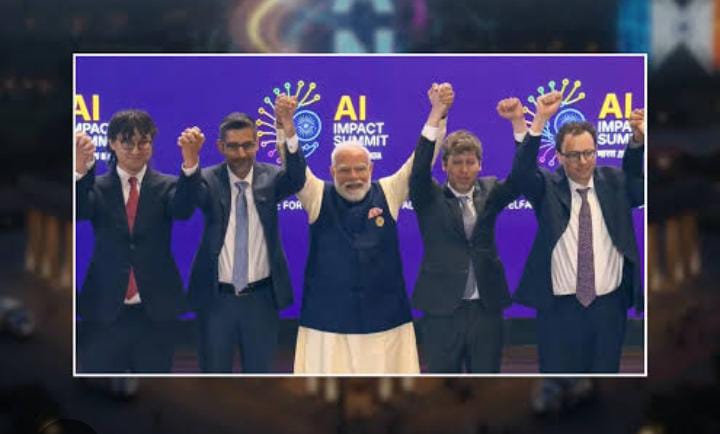
On Day 4 of the India AI Summit 2026, New Delhi became the focal point of a critical global conversation on artificial intelligence. In a keynote address that drew international attention, Prime Minister Narendra Modi unveiled what he described as the “MANAV Vision” — a framework aimed at ensuring that artificial intelligence development remains human-centric, inclusive, and equitable.
The “MANAV Vision” places strong emphasis on incorporating the aspirations of the Global South into the core of AI governance. In his remarks, the Prime Minister highlighted that emerging economies must not merely be consumers of AI technologies but active contributors in shaping global AI standards, policies, and innovation pathways.
According to the address, the rapid expansion of AI presents both immense opportunities and complex challenges. While AI can transform healthcare, agriculture, education, and public services, the absence of balanced governance could widen digital divides. The MANAV Vision seeks to prevent such disparities by promoting responsible innovation, data sovereignty, and collaborative regulation.
The summit, attended by representatives from over 100 countries, has become a platform for dialogue between policymakers, technology executives, researchers, and entrepreneurs. Discussions on Day 4 revolved around ethical AI deployment, cross-border data frameworks, semiconductor manufacturing, and digital public infrastructure.
India’s stance, as articulated in the speech, positions the country as a bridge between advanced AI economies and developing nations. By advocating for inclusive governance models, India aims to ensure that AI solutions address local realities while contributing to global progress.
As debates around AI safety, transparency, and regulation intensify worldwide, the unveiling of the MANAV Vision signals India’s ambition to play a decisive role in shaping the rules of the next technological era. Whether this approach redefines global AI governance frameworks remains to be seen, but Day 4 of the summit has undoubtedly placed India at the center of the conversation.
"The decisions we make today will shape the world for generations to come."