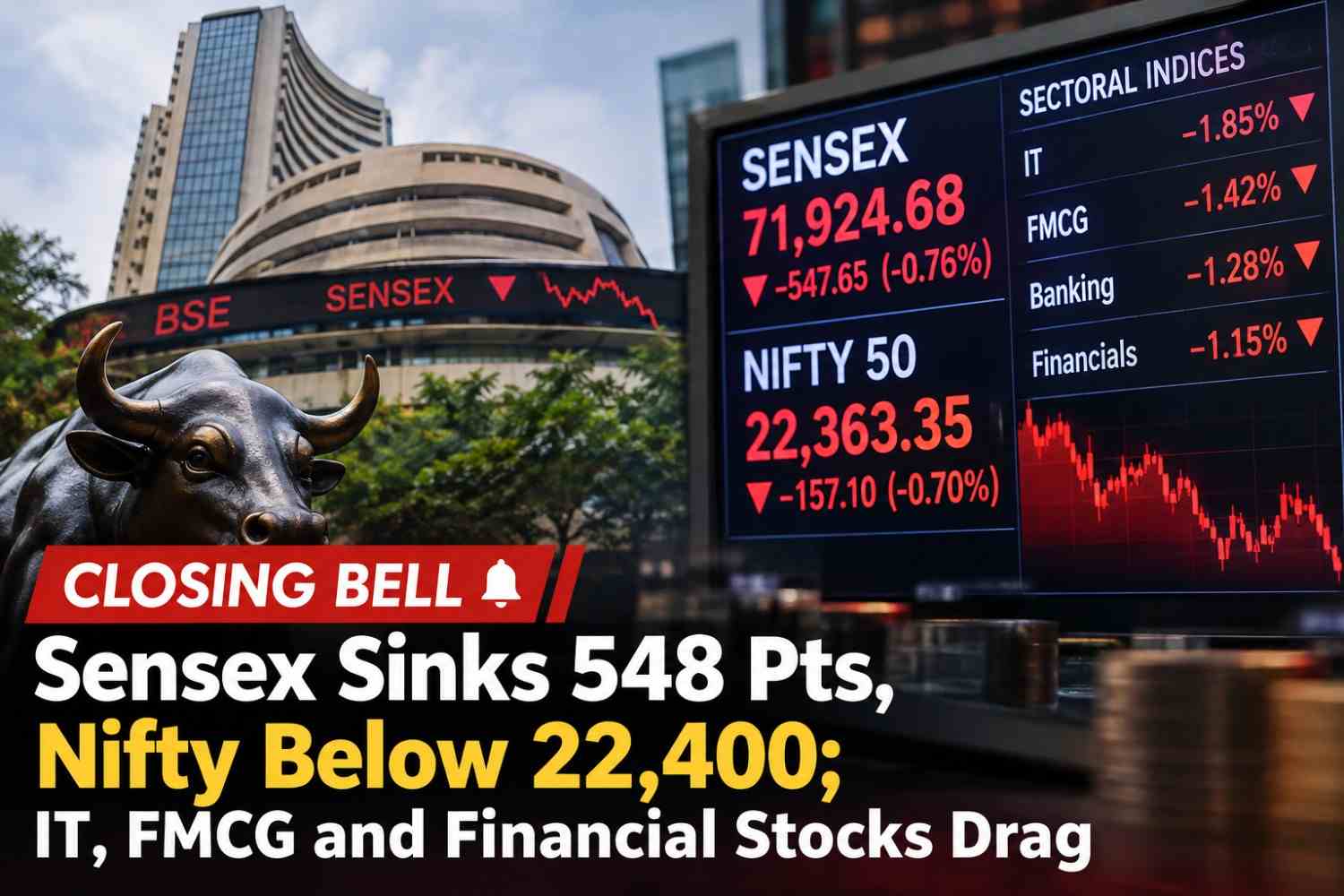
The broader market did not escape the slaughter this week. Nifty Midcap 100 dropped 1.2 per cent and Nifty Smallcap 100 fell 2 per cent in the five sessions ending 24 July 2026, extending losses for a second consecutive week. They still managed to outperform the benchmarks — Nifty 50 plunged 2.32 per cent to close at 23,767.45 and Sensex bled 2.67 per cent, shedding 2,091 points to finish at 76,059.77. Total market capitalisation of BSE-listed companies shrank by nearly ₹5 lakh crore.
On the surface, the relative resilience of mid and smallcaps looks like a technical footnote. Dig deeper and the numbers expose a deeper rot. Private banks led the carnage, with Nifty Private Bank collapsing 4.32 per cent. Realty lost 4.02 per cent, capital markets 2.61 per cent, oil & gas 1.96 per cent and IT 1.57 per cent. Only the usual defensives — FMCG up 0.62 per cent, Auto 0.44 per cent and Media 0.39 per cent — offered any shelter.
Foreign institutional investors continued their flight, dumping equities worth ₹7,182 crore for the second straight week. Domestic institutions tried to play the patriotic buyer, pouring in ₹8,637 crore, yet even that support could not prevent the wealth destruction.
The trigger was not mysterious. Escalating conflict in the Middle East pushed Brent crude toward and briefly above $100 a barrel before it settled near $97. India, still heavily dependent on imported energy despite years of “Aatmanirbhar” slogans, felt the shock immediately. Higher oil prices feed inflation, pressure the rupee, raise input costs for companies already reporting mixed first-quarter results, and force risk-averse global capital to flee emerging markets. The government has had more than a decade to reduce this vulnerability through aggressive domestic exploration, strategic reserves expansion and genuine diplomatic insulation. Instead, every fresh flare-up in West Asia turns into a direct hit on Indian balance sheets and household budgets.
Technical analysts are now openly cautious. Support for Nifty is being watched near 23,600–23,650; a decisive break could open the path toward 23,400 or lower. Resistance clusters around 23,950–24,150. Momentum indicators have turned weak. The short-term advice from the Street is the same: reduce leverage, avoid aggressive longs, and treat any bounce as an opportunity to exit rather than an invitation to buy.
What makes this week particularly damning is the pattern. This is not an isolated global risk event. It is the latest demonstration that India’s economic architecture remains dangerously exposed. Mid and smallcap companies — the supposed engines of job creation and domestic growth — are still the first to be punished when external shocks arrive. Retail investors who piled into these stocks during the previous bull run are once again left holding the losses while policymakers issue statements about “resilience” and “strong fundamentals.”
The outperformance of mid and smallcaps relative to the large-cap indices this week should not be celebrated. It merely shows that the selling was concentrated in a few heavyweight sectors rather than a broad-based flight from risk. Stock-specific pain was severe: several smallcap names fell between 7 and 22 per cent, while only a handful of selective names managed gains of 6–12 per cent. That is not resilience; it is selective survival in a market that is still bleeding.
Until the structural dependence on imported oil is seriously addressed, until foreign capital is given consistent policy predictability rather than abrupt regulatory surprises, and until earnings growth becomes broad-based instead of concentrated, every external tremor will continue to extract a higher price from Indian savers than from the political class that claims credit for every temporary recovery.
The second straight week of losses is not just a market statistic. It is another reminder that the gap between official narrative and lived economic reality continues to widen.
"The decisions we make today will shape the world for generations to come."