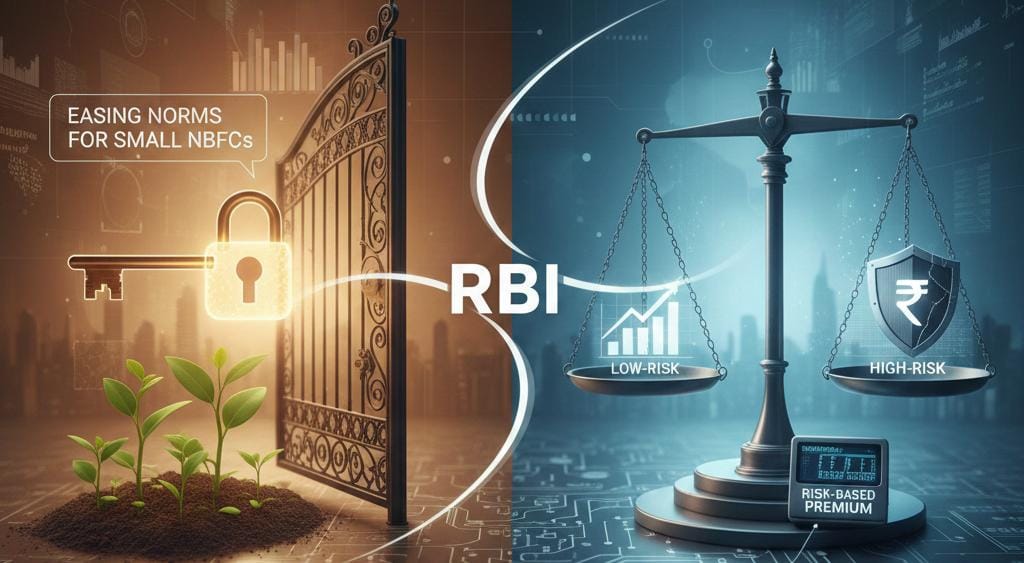
In a significant recalibration of India’s financial architecture, the Reserve Bank of India (RBI) recently unveiled a dual-track strategy designed to foster growth in the grassroots credit market while tightening the safety net for the broader banking system. By easing registration and operational norms for specific classes of Non-Banking Financial Companies (NBFCs) and introducing a "Risk-Based Premium" (RBP) model for deposit insurance, the central bank is signaling a move toward "proportional regulation"—where the intensity of oversight matches the level of systemic risk.
The Great De-cluttering: Relief for Small NBFCs
For years, the "shadow banking" sector has been under an increasingly tight regulatory leash, following the collapse of major players like IL&FS. However, the RBI has now recognized that a "one-size-fits-all" approach may be stifling the very entities that drive financial inclusion in niche markets.
1. Exemption from Registration
In a landmark move, the RBI has proposed that Type-I NBFCs—entities that do not access public funds and have no direct customer interface—will be exempted from the mandatory registration requirement, provided their asset size does not exceed ₹1,000 crore.
This is a massive win for:
Investment Holding Companies: Private entities created solely to hold investments.
Fintech Backend Entities: Tech-led lenders that operate in B2B environments without touching retail deposits.
Small-scale Shadow Banks: Niche players that utilize their own capital to provide credit.
2. Branch Expansion Freedom
The RBI is also removing the "red tape" for NBFC-Investment and Credit Companies (NBFC-ICCs) engaged in gold loans. Previously, these entities needed prior approval to open new branches once they crossed the 1,000-branch threshold. That requirement has been scrapped, allowing established gold-loan players to scale up rapidly to meet rural credit demand.
The Shift to "Risk-Based Premium" (RBP) for Deposit Insurance
While the NBFC sector sees a loosening of the reins, the banking sector is preparing for a sophisticated shift in how it pays for depositor safety. Effective April 1, 2026, the Deposit Insurance and Credit Guarantee Corporation (DICGC) will ditch its decades-old "flat-rate" system in favor of a model that rewards financial discipline.
The New Premium Structure
Currently, every bank pays a flat fee of 12 paise per ₹100 of deposits. Under the new RBP framework, banks will be categorized into four buckets based on their solvency, asset quality (Net NPAs), and governance standards.
Why this matters for the Economy
- Incentivizing Health: The 33% discount for Category A banks provides a direct bottom-line incentive for lenders to maintain low NPAs and high Capital Adequacy Ratios (CRAR).
- Ending Cross-Subsidization: Under the old system, well-managed, conservative banks were essentially subsidizing the insurance costs of riskier, poorly managed institutions. The RBP model brings "actuarial fairness" to the system.
- Confidentiality as a Shield: To prevent "bank runs," the RBI has mandated that a bank’s specific risk category (A, B, C, or D) must remain strictly confidential between the regulator and the bank's MD/CEO. This prevents the public from identifying "weaker" banks solely based on their premium tier.
Strategic Implications: The "Carrot and Stick" Approach
These twin moves represent a sophisticated "carrot and stick" philosophy.
The "Carrot" is for the small NBFCs and high-performing banks. By reducing the compliance burden for entities with low systemic risk (Type-I NBFCs) and lowering costs for healthy banks, the RBI is freeing up capital that can be deployed toward productive lending. This is particularly crucial as the government targets a "Viksit Bharat 2047" roadmap, which requires a credit-to-GDP ratio significantly higher than current levels.
The "Stick" (or rather, the pressure) is for the riskier elements of the financial system. Weaker banks will now feel the pinch of higher insurance costs compared to their peers, creating internal pressure to reform. Meanwhile, for the consumer, the safety net remains ironclad: the ₹5 lakh insurance cover per depositor remains unchanged, ensuring that despite the back-end changes, the common man's money remains protected.
The Road Ahead
As we approach April 2026, the financial sector will likely see:
A Surge in Corporate Structure Re-alignment: Many companies may restructure their NBFC arms to fit into the Type-I exemption category to save on compliance costs.
- Aggressive Cleaning of Balance Sheets: Banks in Category B or C will likely strive to reach Category A to benefit from the lower premium, leading to better asset quality across the industry.
- Expansion in Rural Lending: With easier branch norms for gold-loan NBFCs, expect a deeper penetration of formal credit in India’s hinterlands.
The RBI is no longer just a "regulator"; it is acting as a "market architect," building a system where efficiency is rewarded and risk is priced with surgical precision.
"The decisions we make today will shape the world for generations to come."