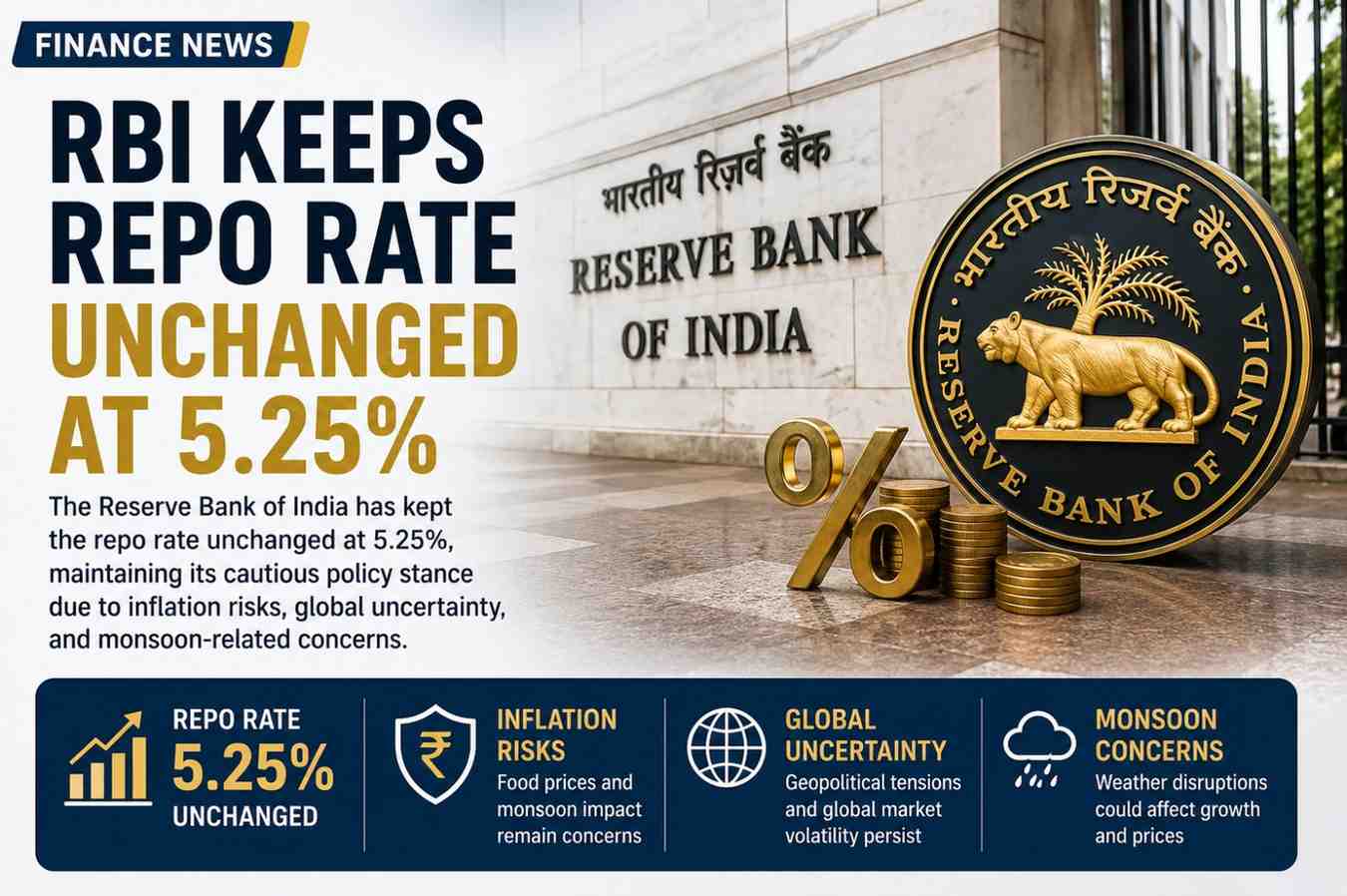
The Reserve Bank of India (RBI) has decided to keep the repo rate unchanged at 5.25%, continuing its cautious approach to monetary policy. The decision reflects the central bank's effort to maintain price stability while supporting India's economic growth in an uncertain global environment.
The Monetary Policy Committee (MPC) noted that inflation remains a key concern despite signs of moderation in recent months. Rising food prices, weather-related disruptions during the monsoon season, and global geopolitical tensions continue to pose risks to the inflation outlook. By leaving the repo rate unchanged, the RBI aims to ensure that inflation remains under control without putting unnecessary pressure on economic activity.
The repo rate is the interest rate at which the RBI lends money to commercial banks. It plays a significant role in determining borrowing costs across the economy. When the repo rate remains stable, lending and deposit rates generally see limited changes, providing predictability for borrowers, businesses, and financial institutions.
The RBI also highlighted the importance of monitoring global developments, including fluctuations in crude oil prices, international financial markets, and trade-related uncertainties. These external factors could influence inflation and capital flows, making it necessary for the central bank to remain vigilant.
Economists believe the decision signals confidence in the current economic recovery while leaving room for future policy adjustments if inflationary pressures increase or growth slows. Stable interest rates are expected to support investment, consumer spending, and business expansion without creating additional inflationary risks.
For borrowers with home, vehicle, and business loans linked to external benchmark rates, the RBI's decision means EMIs are likely to remain unchanged for now. Banks are also expected to maintain existing lending and deposit rates unless market conditions change significantly.
Going forward, investors and businesses will closely watch upcoming inflation data, economic growth figures, and global market trends, as these factors will influence the RBI's future monetary policy decisions. The central bank has reiterated that its priority remains achieving sustainable growth while ensuring inflation stays within its target range.
Overall, the RBI's decision to keep the repo rate at 5.25% reflects a balanced approach, aiming to preserve financial stability, support economic momentum, and remain prepared for evolving domestic and global challenges.
"The decisions we make today will shape the world for generations to come."