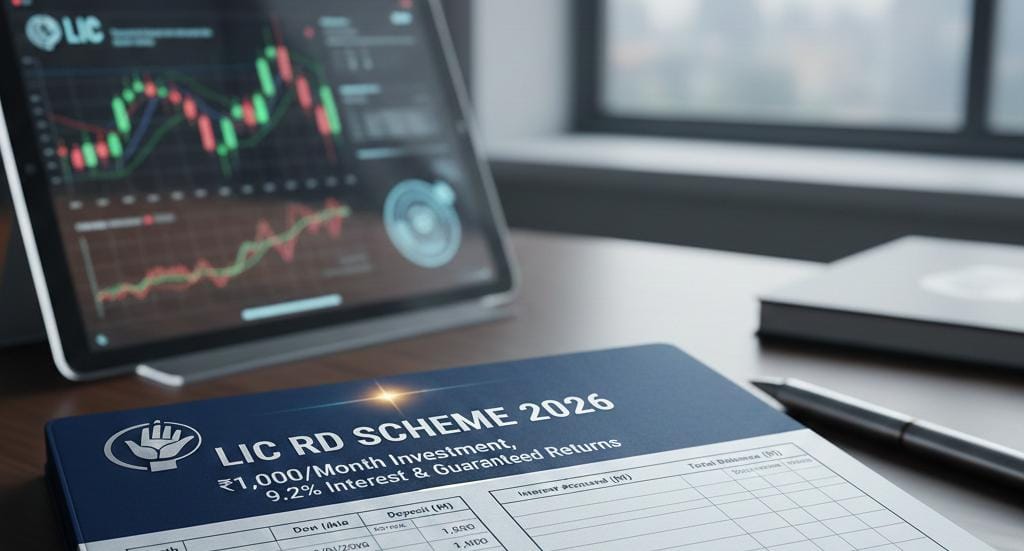
The Indian financial landscape in 2026 is evolving rapidly. Following the recent Union Budget 2026, where fiscal discipline and simplified taxation took center stage, the conversation around safe-haven investments has reached a fever pitch. Among the most discussed topics is the "New LIC RD Scheme 2026."
Rumors and viral social media posts have claimed the launch of a groundbreaking Recurring Deposit (RD) style plan from the Life Insurance Corporation of India (LIC) offering a staggering 9.2% interest rate for a modest investment of ₹1,000 per month. But does such a plan truly exist in the form described, or is it a clever packaging of existing endowment and money-back policies?
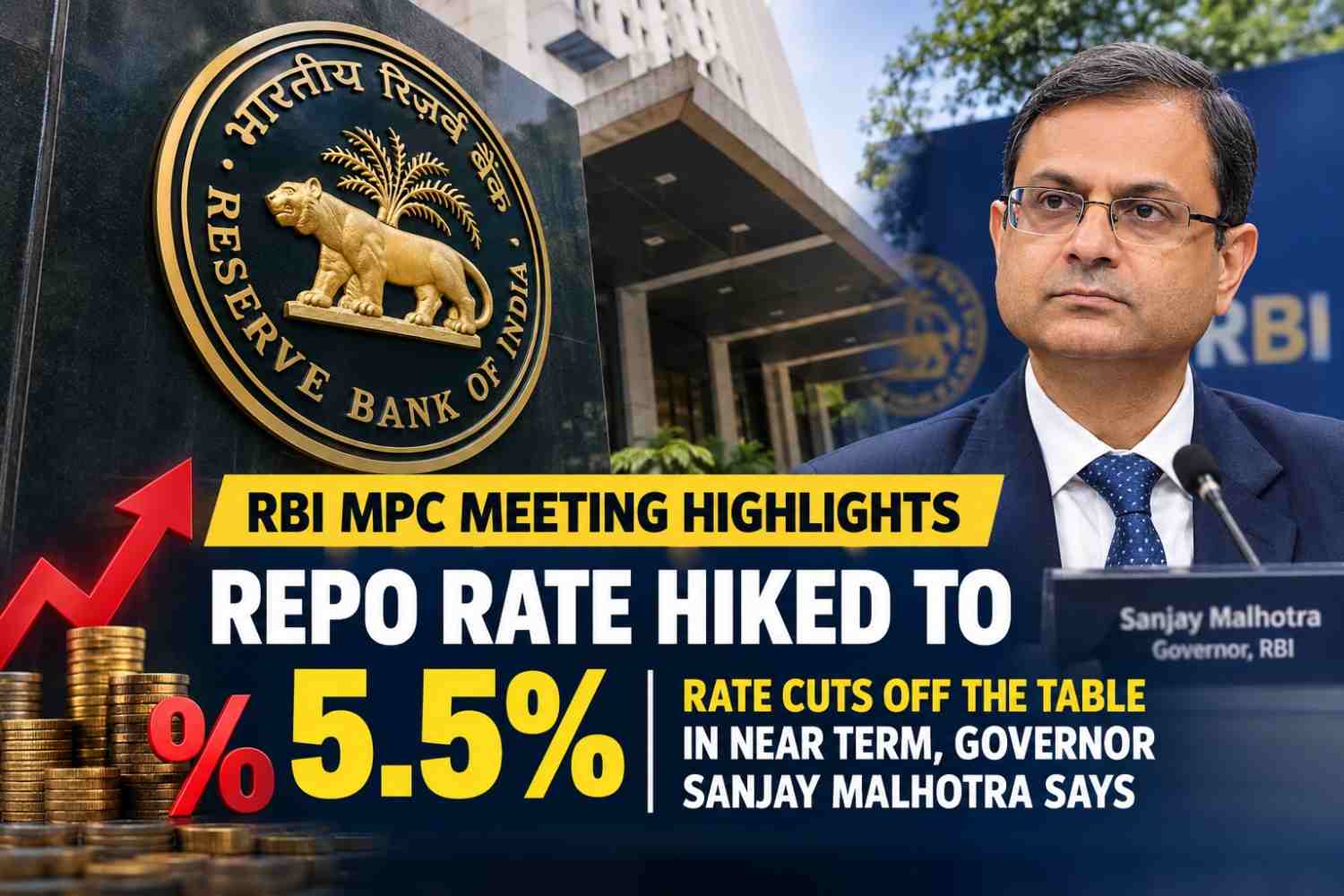
As we navigate an era where the Repo Rate remains a critical lever for the RBI and market yields are under constant scrutiny, it is vital for investors to separate marketing "hype" from actual policy terms.
1. The Myth vs. Reality: Does LIC Have an 'RD' Scheme?
Technically, the Life Insurance Corporation of India (LIC) does not offer a "Recurring Deposit" in the same way a commercial bank like SBI or HDFC does. A traditional bank RD is a pure savings instrument where you deposit a fixed amount monthly and receive the principal plus interest at the end of the tenure.
What is often marketed as an "LIC RD" is actually an Endowment or Money-Back Insurance Plan. In these plans:
- The "Deposit" is actually a Premium.
- The "Interest" is a combination of Guaranteed Additions and Loyalty Bonuses.
- The "Maturity" includes a Sum Assured plus accumulated bonuses.
The current buzz surrounding a 9.2% return is likely a calculated projection of certain "With-Profit" plans or a misinterpretation of the internal rate of return (IRR) over a very long horizon.
2. Analyzing the 9.2% Claim in 2026
In the current economic climate, where the Government of India is focusing on reducing the fiscal deficit to 4.3% of GDP (as per the Feb 2026 Budget), interest rates on fixed-income instruments generally range between 6.5% to 7.8%.
A 9.2% guaranteed return is significantly higher than the prevailing market rates for debt instruments. However, LIC plans often achieve high "effective" returns through:
Tax Savings: Under the Old Tax Regime (Section 80C) and the tax-free nature of maturity proceeds (Section 10(10D)), the "net" return for an investor in the 30% tax bracket can feel like 9% or more.
Long-Term Compounding: LIC plans are designed for 15, 20, or 25 years. The power of compounding, combined with terminal bonuses, can significantly boost the final corpus.
3. Key Features of LIC’s 2026 Small-Ticket Plans
For those looking to start with just ₹1,000 per month, LIC has refreshed several of its classic "Navratna" plans to align with the 2026 financial regulations.
- A. LIC New Money Back Plan (20 & 25 Years)
- This is the closest equivalent to an "RD with benefits."
- Monthly Commitment: Can be started with as little as ₹1,000–₹1,500 depending on the age of the proposer.
Survival Benefits: Unlike a bank RD, this plan pays you a percentage of the Sum Assured every 5 years (for the 20-year plan) or every 5 years (for the 25-year plan).
The '9.2%' Angle: While the base interest isn't 9.2%, the periodic payouts can be reinvested to achieve a higher compounded yield.
B. LIC Jeevan Labh & Jeevan Anand
These remain the flagship products for 2026.
Guaranteed Returns: They offer a "Sum Assured on Maturity" which is legally guaranteed.
Protection: In the event of the policyholder's demise, the family receives the full Sum Assured regardless of how many "RD" installments (premiums) were paid.
4. Why ₹1,000/Month is the Magic Number in 2026
Following the 2026 Budget's focus on "Inclusive Growth," there has been a push for micro-insurance and small-ticket savings. Investing ₹1,000 per month is an entry-point for:
- Young Professionals: Starting their first job and looking for a disciplined savings habit.
- Rural Investors: Seeking the "Sovereign Guarantee" that only LIC provides.
- Parents: Planning for a child’s education 15 years down the line.
- Expert Note: In 2026, the real value of ₹1,000 is lower than a decade ago due to inflation. To truly benefit from an LIC plan, one should consider an "Increasing Premium" approach or a plan with a high "Bonuses" history.
5. Understanding "Guaranteed Returns" in the New Era
The term "Guaranteed" is the most powerful word in Indian finance. For the 2026 schemes, LIC has introduced Guaranteed Additions (GA).
How it works: For every ₹1,000 of the Sum Assured, LIC adds a fixed amount (e.g., ₹40 or ₹50) to your policy every year.
The Catch: These are added to the corpus but paid out only at maturity or death.
While the 9.2% figure might be an optimistic calculation involving the most aggressive bonus scenarios, the safety of the principal is 100% guaranteed by the Government of India’s sovereign guarantee on LIC policies.
6. Final Verdict: Should You Invest?
If you are looking for a pure 9.2% interest rate to pay your bills next year, an LIC plan is not for you. You would be better served by Senior Citizen Savings Schemes (SCSS) or certain high-yield Corporate FDs.
However, if your goal is Total Financial Security, the "New LIC RD Scheme 2026" (Endowment/Money-Back) is an excellent choice for:
Tax-free wealth creation.
Enforced discipline (you can't easily withdraw the money on a whim).
Peace of mind knowing that your family is protected even if you aren't there to complete the "RD" installments.
Summary Checklist for Investors:
Check the UIN: Every LIC plan has a Unique Identification Number. Verify the 9.2% claim against the official brochure on licindia.in.
Verify the Term: Most "high return" projections require a 20-25 year commitment.
Consult an Agent: Ask for the "Benefit Illustration" which shows the guaranteed vs. non-guaranteed (bonus-based) returns.
"The decisions we make today will shape the world for generations to come."