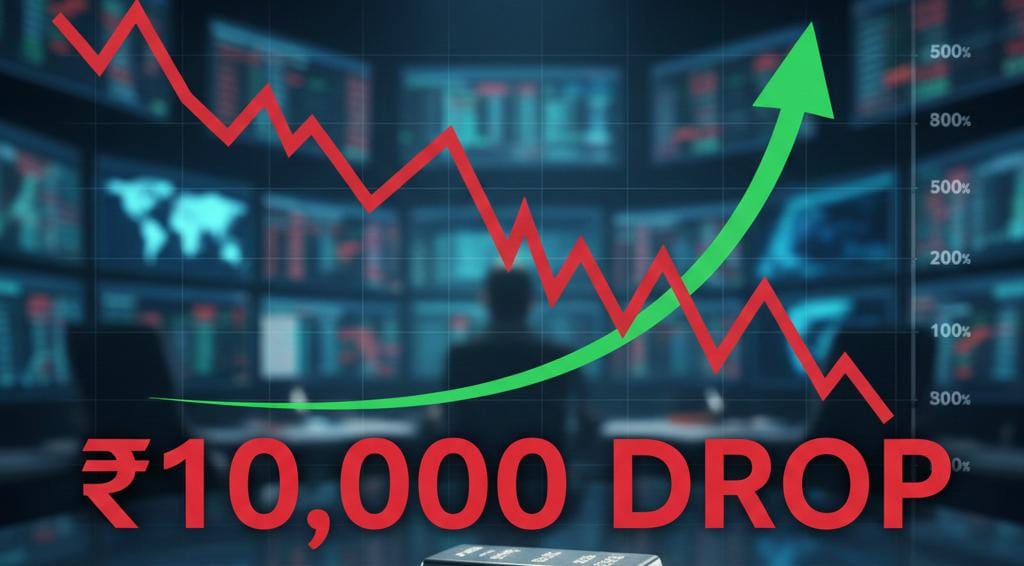
The silver market, often dubbed the "restless sibling" of gold, lived up to its reputation in spectacular fashion this January. After a relentless bull run that saw prices breach the historic ₹3,15,000 per kg mark on the Multi Commodity Exchange (MCX), the market witnessed a jarring correction. In a single trading session on Thursday, January 22, 2026, silver prices plummeted by over ₹10,000 per kilogram, sending shockwaves through the portfolios of retail investors and jewelers alike.
For an asset that had surged over 100% in the preceding three months, this sudden "flash crash" raised a critical question: Is this the end of the silver super-cycle, or merely a healthy pitstop before the next leg up?
The Anatomy of a Crash: What Triggered the ₹10,000 Slide?
Financial markets rarely move in a vacuum, and silver’s sudden descent was fueled by a "perfect storm" of geopolitical shifts and the popping of a domestic speculative bubble.
1. The "Greenland De-escalation"
The primary catalyst for the global pullback was a sudden shift in rhetoric from Washington. Earlier in the week, prices had skyrocketed on fears of escalating tensions between the U.S. and the European Union. However, President Donald Trump’s comments at the Davos summit—stating that the U.S. would not use military force regarding Greenland and signaling a framework deal with NATO—instantly sucked the "risk premium" out of the market. As geopolitical anxiety faded, the safe-haven demand that had propped up silver vanished almost overnight.
2. The Unwinding of the India-Specific "Budget Premium"
In India, the fall was magnified by local factors. For weeks, rumors had swirled that the Union Budget (scheduled for February 2026) might see a hike in customs duty on precious metals. This led to aggressive "front-running" by domestic traders, pushing Indian silver prices to a rare $13 premium over international COMEX prices. When it became clear that no such duty hike was imminent, this "artificial" premium collapsed, leading to a much sharper fall in India compared to global spot markets.
3. The ETF Liquidation Panic
Perhaps the most dramatic scenes played out in the Silver ETF (Exchange Traded Fund) market. Major funds like Nippon India, ICICI Prudential, and Tata Silver ETF saw intraday plunges of 15% to 20%. This was exacerbated by:
Margin Calls: Many traders were holding positions on borrowed capital; when prices dipped, forced liquidations triggered a domino effect.
iNAV Disconnect: ETFs were trading at massive premiums to their actual Net Asset Value. Once the sentiment turned, these premiums evaporated, leading to a "double-whammy" for investors.
The Fundamental Tug-of-War: Why Silver is Different in 2026
To understand if a comeback is likely, one must look beyond the price charts. Unlike gold, which is primarily a monetary asset, silver is a "dual-identity" metal. It is half-safe-haven and half-industrial-workhorse.
The Industrial Squeeze
In 2026, silver has reached a status similar to rare earth minerals. Industrial demand now accounts for nearly two-thirds of total consumption.
Solar Energy: Despite gains in panel efficiency, the sheer volume of global solar installations (estimated at 655 GW in 2025) has created a structural floor for demand.
The EV and AI Boom: Silver’s unmatched electrical conductivity makes it indispensable for EV power electronics and the high-speed hardware required for AI data centers.
Supply Deficits: For the fifth consecutive year, the silver market is in a structural deficit. Most silver is a byproduct of copper and zinc mining; because these base metals haven't seen a matching surge, silver production cannot simply be "turned on" to meet demand.
"Silver is both money and an industrial metal. That means it gets hit harder on optimism... and rebounds faster when reality returns." — Robert Kiyosaki, Author of Rich Dad Poor Dad, commenting on the January crash.
Technical Outlook: Will it Fall Further?
From a technical perspective, the crash has "cleaned out" the overleveraged players, which is often a precursor to a more sustainable rally.
Support Levels: Analysts point to a strong floor at the ₹3,00,000 to ₹3,05,000 zone on the MCX. As long as prices hold above this level, the long-term bullish structure remains intact.
Resistance: On the upside, ₹3,30,000 remains the immediate hurdle. A decisive close above this would signal that the "Greenland correction" is over.
The RSI Divergence: Before the crash, the Relative Strength Index (RSI) had signaled a "bearish divergence"—prices were making new highs, but momentum was slowing. This recent drop has neutralized that overbought condition, making the market "healthier" for new entrants.
Strong Comeback or Slow Bleed? The Expert Verdict
While the immediate volatility is stomach-churning, most institutional analysts remain constructive on silver for the remainder of 2026. GlobalData recently revised its end-of-year target for silver to a staggering $175–$220 per ounce, translating to domestic Indian prices potentially exceeding ₹4,00,000 per kg by December.
The rationale is simple: while geopolitics can cause temporary dips, the scarcity of physical silver is a math problem that cannot be solved by a tweet or a policy shift.
Strategies for Investors
Avoid the "Premium Trap": If buying ETFs, always check the iNAV (Indicative Net Asset Value). Never buy when the market price is significantly higher than the underlying value of the silver.
The "Staggered" Approach: Rather than a lump-sum investment, use these ₹10,000+ dips to average your costs.
Long-term Horizon: Silver is currently a high-beta asset. It is not for the faint of heart or for capital needed within the next six months.
The ₹10,000 crash was a brutal reminder that what goes up vertically often comes down the same way. However, for the patient investor, this correction might be the "golden" (or rather, silver) opportunity of the year. The transition to green energy and the digital revolution are built on a foundation of silver, and as long as supply remains constrained, the path of least resistance for the white metal remains upward.
The "plummet" may feel like a crisis today, but in the rearview mirror of 2026, it may well be remembered as the last great buying opportunity before silver truly went "to the moon."
"The decisions we make today will shape the world for generations to come."