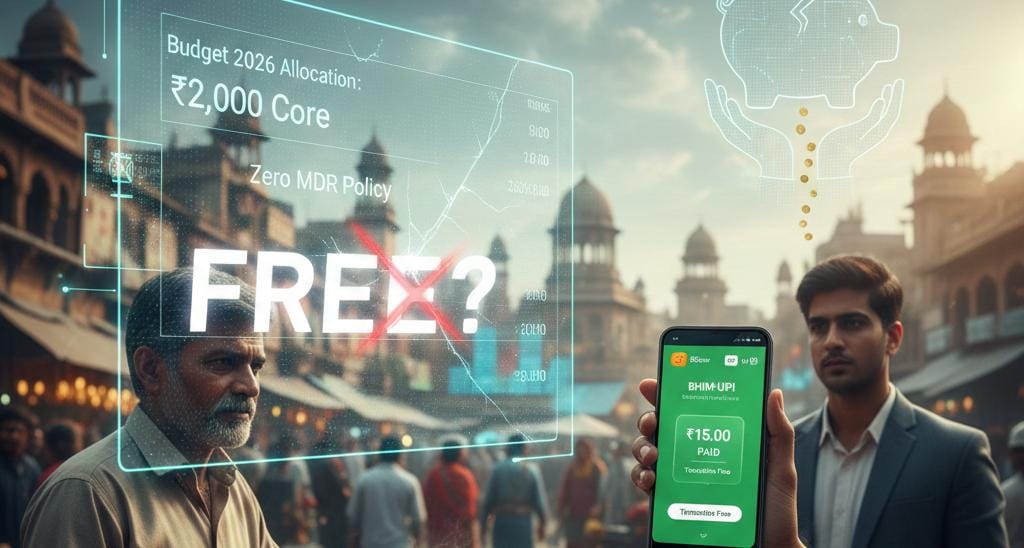
The Union Budget 2026 has sent a clear, albeit complicated, message to India’s booming fintech sector. Finance Minister Nirmala Sitharaman announced an allocation of ₹2,000 crore to subsidize low-value BHIM-UPI transactions and RuPay debit card payments for the 2026-27 fiscal year. While this move reinforces the government’s commitment to keeping digital payments "free" for the masses, the reduced outlay compared to previous revised estimates has reignited a fierce debate: How long can a world-class payment infrastructure run on subsidies before the "free" model begins to fracture?
The ₹2,000 Crore Reality Check
For the uninitiated, the government provides these incentives to banks and payment service providers (PSPs) to compensate them for the Zero Merchant Discount Rate (MDR) policy. Under this policy, merchants pay nothing to accept UPI or RuPay debit card payments, a factor the Economic Survey 2025-26 credits for India’s unprecedented financial inclusion.
However, the industry’s reaction to the ₹2,000 crore figure has been lukewarm at best.
The Squeeze: The allocation is roughly 10% lower than the ₹2,196 crore revised estimate for FY26.
Industry Expectations: Groups like the Payments Council of India (PCI) had lobbied for an outlay closer to ₹10,000 crore to match the exponential growth in transaction volumes.
The Volume Gap: In January 2026 alone, UPI processed 21.7 billion transactions. Distributing ₹2,000 crore over an entire year of such staggering volume means the "incentive" per transaction is becoming microscopic.
The "Free" Illusion: Is There a Hidden Cost?
While the consumer and the small tea-stall owner still see a ₹0.00 transaction fee, the plumbing behind the scenes is under pressure. The cost of maintaining servers, preventing fraud, and expanding QR code networks in rural "hinterlands" is rising.
1. The Infrastructure Bottleneck
Experts argue that a stagnant subsidy pool acts as a soft cap on innovation. If PSPs like PhonePe, Google Pay, and Paytm—who control roughly 90% of the market—cannot monetize the core transaction, they must pivot to "side-hustles" like selling insurance, personal loans, or soundbox subscriptions. While this has helped companies like Paytm move toward profitability, it diverts focus from the core payment experience's reliability.
2. The RuPay Credit Card Complication
A significant shift in 2025-26 has been the rise of RuPay Credit Cards on UPI. Unlike bank-to-bank UPI, these carry an MDR. Many merchants are now seeing "inexplicable" deductions on their end-of-day settlements, which are actually fees for credit-linked transactions. This is creating a "two-tier" UPI experience where the "free" tag only applies to certain types of transactions, leading to confusion at the point of sale.
Will the Government Blink on MDR?
The "MDR vs. Subsidy" tug-of-war is reaching a stalemate. The government’s stance is rooted in social equity; the Economic Survey highlights that digital payments have created a "verifiable transaction history" for millions of previously "unbanked" Indians, allowing them to access formal credit for the first time.
However, industry veterans like Vishwas Patel (Chairman of PCI) suggest a middle ground: Targeted MDR.
"The government could look at bringing a 30 basis points (0.3%) charge on payments made to merchants with an annual turnover of more than ₹20 lakh."
By protecting the "Kirana" stores (small retailers) while charging large enterprises, the ecosystem could become self-sustaining without hurting the common man. Yet, for now, the Budget 2026 stick to the status quo—choosing to subsidize rather than charge.
The Verdict: Will UPI Stay Free?
For the 2026-27 period, yes, UPI and RuPay will remain essentially free for the end-user and the small merchant. The ₹2,000 crore allocation ensures that the "Zero MDR" regime isn't dismantled overnight.
But the "subsidy model" is showing signs of fatigue. As India aims for 1 billion transactions per day, a fixed subsidy pool will eventually become spread too thin to support the necessary cybersecurity and hardware upgrades. We are likely entering the final years of the "completely free" era, transitioning toward a hybrid model where value-added services and large-merchant fees carry the weight of the infrastructure.
"The decisions we make today will shape the world for generations to come."