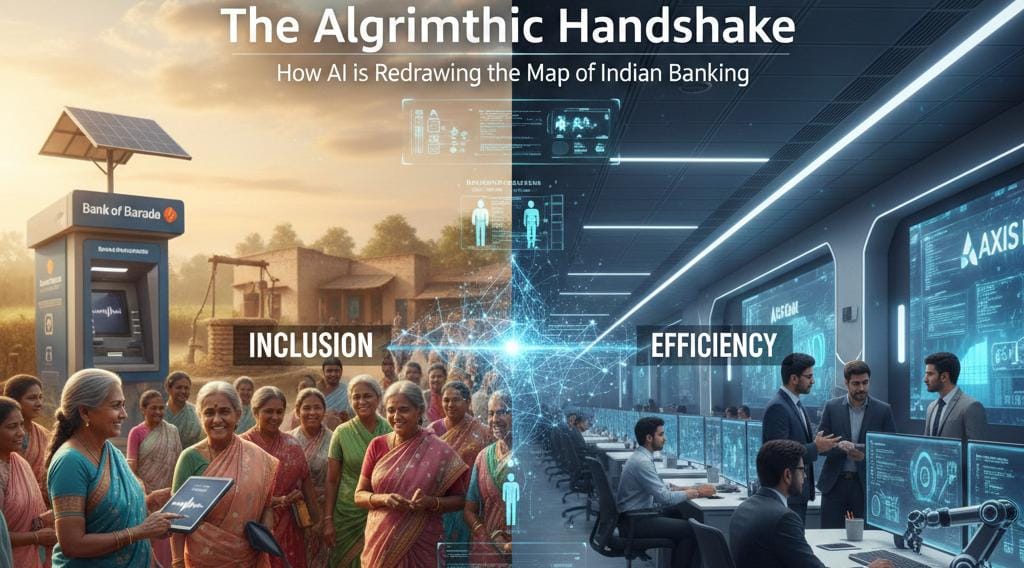
The Indian banking sector, once the fortress of manual ledgers and face-to-face interactions, is undergoing a transformation so profound that it is altering both the customer experience and the very definition of a "banker." In early 2026, two headlines have emerged as polar symbols of this shift: Bank of Baroda is piloting cutting-edge AI-based language applications to bridge the rural-urban divide, while Axis Bank has reported a reduction of over 950 employees in a single quarter, citing the dividends of long-term technology and automation investments.
These developments represent the two faces of the same coin—Innovation and Optimization.
1. Bank of Baroda: Breaking the Language Barrier
While the digital revolution has touched millions, a significant portion of India's population remains sidelined due to language barriers. Bank of Baroda’s (BoB) recent pilot of AI-based language apps is a strategic move to solve this "accessibility debt."
The Multilingual Mandate
BoB is leveraging Generative AI (GenAI) and Natural Language Processing (NLP) to create a conversational layer that understands regional dialects beyond standard Hindi or English. The pilot aims to allow customers in Tier-III and Tier-IV towns to interact with their accounts using voice commands in their native tongue.
Voice-First Banking: By allowing users to check balances or initiate transfers via voice, the bank is catering to semi-literate populations who find traditional app interfaces daunting.
Hyper-Personalization: These AI apps don't just translate; they adapt. They can explain complex financial products like insurance or micro-loans in a way that resonates with local cultural contexts.
This initiative follows the broader "Social AI" trend highlighted in the Union Budget 2026, where technologies like Bharat-VISTAAR are being encouraged to bring inclusivity to the forefront of the digital economy.
2. Axis Bank: The Cost of Efficiency
If Bank of Baroda represents the expansion of banking’s reach through AI, Axis Bank represents the sharpening of its internal mechanics. The news that Axis Bank reduced its workforce by over 950 employees in Q3 FY26 sent ripples through the industry.
Productivity Gains vs. Headcount
The bank’s leadership has been transparent: the reduction is largely a result of productivity gains from past technology investments.
Back-Office Automation: Routine tasks such as document verification, KYC processing, and simple loan approvals are now handled by "agentic" AI systems.
The Shift in Staff Costs: Chief Financial Officer Puneet Sharma noted that staff costs have declined sequentially. For a private lender, this leaner structure is essential to maintain competitive margins against fintech disruptors.
While Axis Bank previously maintained that AI would not lead to overall job losses, the reality of 2026 shows a "re-balancing." The roles being eliminated are primarily entry-level, repetitive, and administrative. In their place, the bank is hiring for high-value roles in data science, cybersecurity, and specialized customer advisory.
3. The Structural Shift: A K-Shaped Workforce
The contrast between these two banks illustrates a K-shaped recovery in the labor market.
The Upward Arm: Demand is surging for professionals who can manage AI, interpret data, and handle complex "human-centric" grievances.
The Downward Arm: Traditional roles—data entry, basic teller functions, and middle-management oversight of manual processes—are being commoditized or erased.
"We are 6 to 12 months from AI doing everything software engineers do... the same applies to the back-office of a bank." — Dario Amodei, CEO of Anthropic (reflecting the sentiment of the 2026 tech sell-off).
4. The Future: "Yuva Shakti" and the AI Audit
The Indian government has recognized this friction. The 2026 Union Budget established a High-Powered Standing Committee on Education to Employment to audit the impact of AI on jobs. The goal is to ensure that India’s youth are not sidelined by automation but are instead trained to use AI as a "force multiplier."
For the banking professional of 2026, the message is clear: Reskilling is no longer a choice; it is a survival tactic. The "safe" roles are those that require empathy, ethical judgment, and the ability to navigate the "audacious" decisions that machines cannot yet handle.
The New Banking Equilibrium
The pilot at Bank of Baroda and the workforce reduction at Axis Bank are not contradictory; they are the twin engines of a modern economy. One expands the pie, while the other ensures the pie is produced as efficiently as possible.
As AI continues to mature, we should expect more "language pilots" and more "automated redundancies." The banks that thrive will be those that successfully marry the efficiency of the machine with the trust and nuance of the human touch.
"The decisions we make today will shape the world for generations to come."