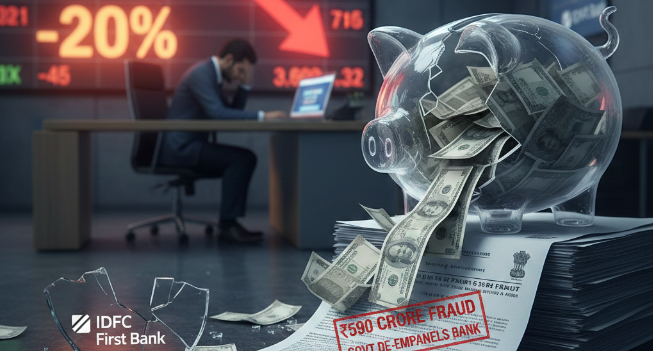
In the world of retail banking, "trust" is the most expensive asset on the balance sheet. For IDFC First Bank, a lender that has spent the better part of a decade rebranding itself as a bastion of digital transparency and consumer-centricity, that asset took a massive hit on February 23, 2026.
The bank’s shares plummeted nearly 20%, wiping out approximately ₹14,000 crore in market capitalization in a single trading session. The catalyst? A disclosure of suspected fraudulent transactions amounting to ₹590 crore ($65 million) at its Chandigarh branch, involving accounts linked to the Haryana State Government.
The Trigger: A Routine Request Unravels a Web
The fraud did not surface through an internal audit or a whistleblower, but via a routine administrative request. In mid-February 2026, a department of the Haryana government approached the bank's Chandigarh branch to close its account and transfer the funds to another lender.
Upon processing the request, bank officials noticed a glaring discrepancy: the balance claimed by the government entity did not match the funds reflected in the bank’s core system. As the bank dug deeper, more government departments reported similar mismatches.
Inside the Breach: Collaboration and Collusion?
Preliminary investigations suggest that the fraud was not a high-tech cyber-attack from the outside, but a more traditional, "old-school" banking fraud: internal collusion.
The bank has suspended four employees at the Chandigarh branch, alleging that they carried out unauthorized transactions, potentially in league with external parties. The nature of the fraud appears to involve manual overrides of the "Maker-Checker-Authorizer" protocol—a standard safety mechanism where one person initiates a transaction, another verifies it, and a third authorizes it.
"Prima facie, the issue is specific to one branch and one client group... it is an isolated instance. There is no system-level issue." — V. Vaidyanathan, MD & CEO, IDFC First Bank.
>
While management has been quick to frame this as a localized failure, the scale—exceeding the bank's entire Q3 net profit of ₹503 crore—has led investors to question the efficacy of the bank’s internal controls.
The Market Reaction: Why the 20% Tank?
A 20% drop is rare for an established private lender. The "Panic of February 23" was driven by three critical factors:
* Earnings Erosion: Analysts from UBS and Morgan Stanley estimated that the fraud could wipe out roughly 20-22% of the bank's projected FY26 Profit After Tax (PAT). In a market that values consistency, a one-off hit of this magnitude is a bitter pill to swallow.
* The "Government" Factor: The fact that public funds were tampered with carries heavy reputational baggage. Shortly after the news broke, the Haryana Government de-empanelled IDFC First Bank, directing all state departments to migrate their funds elsewhere. This move signals a potential "flight of capital" from other institutional clients.
* Shareholder Wealth Destruction: Large institutional holders like the Government of India and LIC saw a combined notional loss of over ₹1,400 crore in just one day.
Mitigation and Recovery: The Road Ahead
To the bank's credit, its response has been swift. Since February 20, 2026, a series of high-level meetings have taken place involving the Board’s Special Committee for Monitoring Fraud and the Audit Committee.
* Forensic Audit: Global firm KPMG has been appointed to conduct a deep-dive forensic investigation, expected to conclude within five weeks.
* Legal & Recovery: Police complaints have been filed, and the bank has sent "recall notices" to beneficiary banks to lien-mark (freeze) suspicious accounts where the stolen funds may have been parked.
* Insurance Cover: The bank reportedly holds insurance against employee dishonesty, which could recover approximately ₹35-40 crore, though this is a small fraction of the total loss.
The Regulatory Stance: "No Systemic Risk"
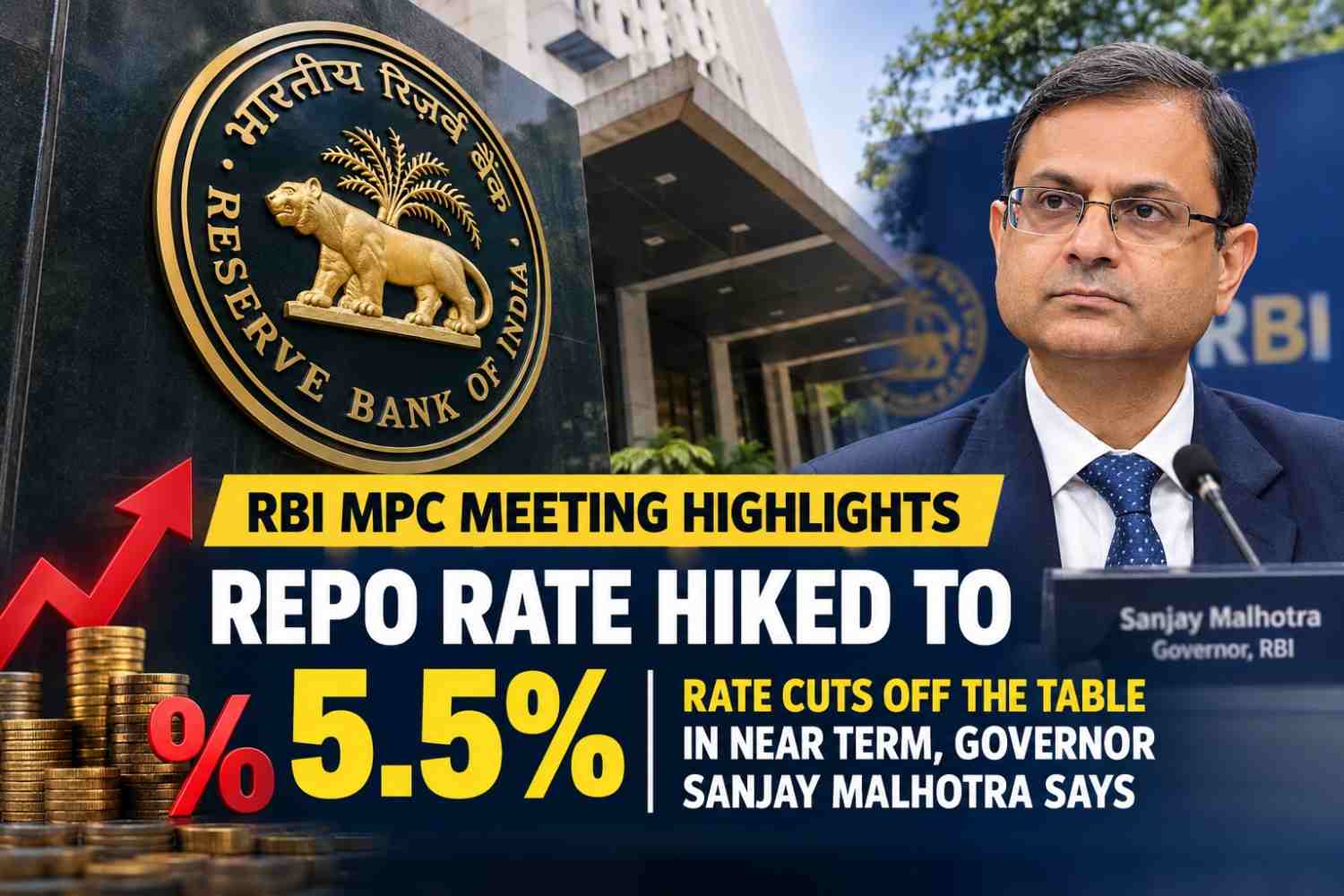
In an attempt to prevent a wider contagion in the banking sector, the Reserve Bank of India (RBI) intervened with a calming statement. RBI Governor Sanjay Malhotra clarified that the central bank is monitoring the situation but sees "no systemic risk" to the Indian financial ecosystem. This suggests that the RBI views the issue as an operational lapse rather than a liquidity or solvency crisis.
A Valuation Trap or a Buying Opportunity?
For investors, IDFC First Bank is currently a battleground. On one hand, the stock is trading at its lowest levels in nearly a year, making valuations look attractive to "bottom fishers." Investec and Jefferies have maintained "Buy" ratings, suggesting the capital impact (roughly 1% of net worth) is manageable.
On the other hand, banking is a business of optics. Until the KPMG audit is released and the bank proves it has patched the holes in its branch-level oversight, the stock is likely to remain under a cloud of uncertainty.
The Chandigarh fraud is a sobering reminder that even in the age of AI and high-frequency digital monitoring, the oldest vulnerability in banking remains the same: the human element.
"The decisions we make today will shape the world for generations to come."