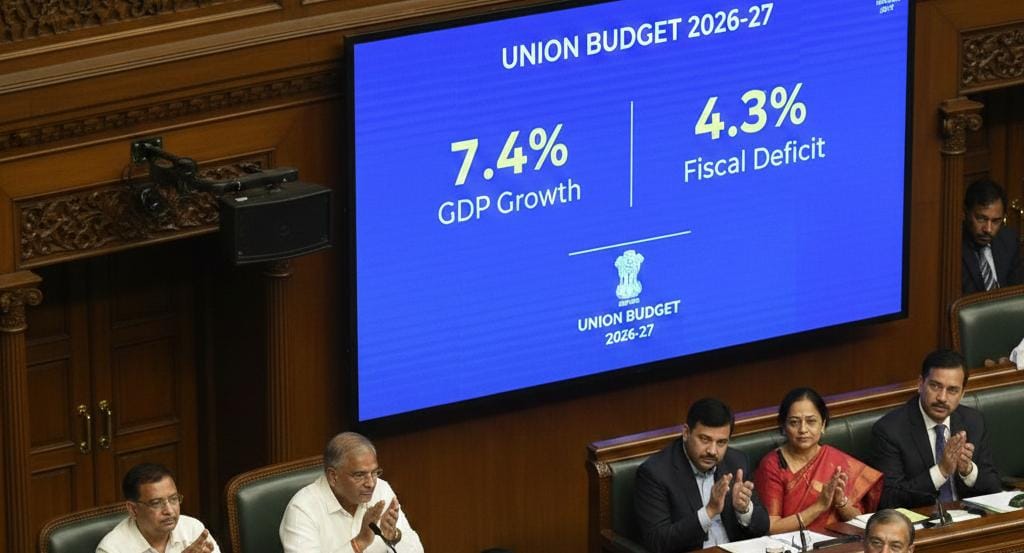
The unveiling of the Union Budget 2026-27 by Finance Minister Nirmala Sitharaman marks a definitive shift in India’s economic narrative. Moving away from the post-pandemic "crisis management" mode, this year’s fiscal roadmap is a sophisticated exercise in policy continuity and strategic foresight. At its heart lies a projected real GDP growth of 7.4%—a figure that cements India’s position as the fastest-growing major economy in a world otherwise characterized by fragmentation and volatility.
For the Indian financial landscape, this budget is not merely an annual ledger of accounts; it is a declaration of intent. It signals that India has earned its macroeconomic stability and is now ready to leverage that foundation to build "strategic indispensability" in the global supply chain.
The Macroeconomic Foundation: 7.4% as the New Baseline
The projection of 7.4% GDP growth for the current fiscal year (FY26) is more than just a number; it is a testament to the resilience of domestic demand and the sustained impact of public capital expenditure. While the global economy grapples with "sticky" inflation and geopolitical friction, India has managed to anchor its inflation near the 4% target, allowing the government to pivot from cooling the economy to fueling its capacity.
The Three 'Kartavyas' (Duties)
The 2026-27 Budget is framed around three central duties that the Finance Minister outlined to guide the nation toward Viksit Bharat (Developed India):
* Accelerating Growth: Enhancing competitiveness through structural reforms.
* Fulfilling Aspirations: Building capacity and skills for the youth and workforce.
* Inclusive Development: Ensuring the "Sabka Saath, Sabka Vikas" philosophy reaches every region and community.
By maintaining a 10% nominal GDP growth projection, the government is signaling a realistic yet optimistic outlook. This balance is critical for investor confidence, as it suggests that the growth is not "hollow" or purely inflationary, but driven by real output.
Fiscal Consolidation: The Path to 4.3%
Perhaps the most significant signal to global markets is the government’s unwavering commitment to fiscal discipline. For FY27, the fiscal deficit target has been set at 4.3% of GDP, a marginal yet meaningful reduction from the 4.4% seen in FY26.
This trajectory is vital for several reasons:
* Reduced Crowding Out: By lowering its borrowing needs, the government leaves more room for the private sector to access credit, which is essential as private investment begins to show signs of a long-awaited revival.
* Sovereign Ratings: A disciplined fiscal path improves India's standing with international rating agencies, potentially lowering the cost of capital for Indian firms looking to expand globally.
* Debt Sustainability: The budget aims to bring the central government debt-to-GDP ratio toward a declining path, targeting a broader 50% ratio by 2030-31.
The Infrastructure Engine: Capex at ₹12.2 Lakh Crore
Infrastructure remains the primary engine of India’s growth story. The Budget has proposed a capital expenditure (Capex) outlay of ₹12.2 lakh crore for FY27—an increase of approximately 9% over the previous year.
This spending is no longer just about "pouring concrete." It is strategically directed toward:
* High-Speed Corridors: Seven new high-speed rail corridors have been proposed (including Mumbai-Pune and Delhi-Varanasi) to reduce logistics costs and improve connectivity between economic hubs.
* Strategic Corridors: The announcement of "Rare Earth Corridors" in states like Odisha and Tamil Nadu highlights a shift toward securing the materials needed for the green energy transition and high-tech manufacturing.
* Industrial Townships: The creation of five university townships near major industrial nodes aims to bridge the gap between education and employment, creating a self-sustaining ecosystem for growth.
Manufacturing and MSMEs: Building Global Champions
With manufacturing's share of GDP historically hovering below 20%, the 2026-27 Budget places a massive bet on "industrial depth." The launch of India Semiconductor Mission (ISM) 2.0 with a ₹40,000 crore outlay and the Electronics Components Manufacturing Scheme are clear indicators that India wants to move up the value chain from assembly to core fabrication.
The MSME Backbone
Recognizing that the 7.4% growth cannot be sustained by large conglomerates alone, the budget introduces several structural supports for Micro, Small, and Medium Enterprises (MSMEs):
* TReDS Integration: Making the use of the Trade Receivables Discounting System (TReDS) mandatory for CPSE purchases ensures that MSMEs have better cash flow.
* SME Growth Fund: A new ₹10,000 crore fund designed to help small businesses scale into "global champions."
* Corporate Mitras: These will be established in Tier II and III towns to help smaller firms navigate the complexities of compliance and GST.
Taxation: Stability over Sensationalism
In a move that surprised some but reassured many, the Finance Minister chose continuity over populism in the tax regime. There were no major changes to the income tax slabs, following the significant relief provided in the previous year.
Instead, the focus shifted to administrative efficiency and ease of living:
* New Income Tax Act, 2025: Coming into effect on April 1, this act aims to simplify the language of the law and reduce litigation.
* Compliance Relief: The deadline for revising returns has been extended to March 31, and TDS (Tax Deducted at Source) rates on certain services have been rationalized to reduce the compliance burden on small businesses.
* Customs Duty Rationalization: Duty exemptions on 17 cancer drugs and components for the MRO (Maintenance, Repair, and Overhaul) aviation sector demonstrate a targeted approach to using trade policy for social and strategic goals.
Challenges on the Horizon
Despite the optimism, the 2026-27 landscape is not without its hurdles. The slowdown in the agricultural sector, which is projected to grow at only 3.1% in real terms, remains a point of concern. The budget attempts to address this through the "Mahatma Gandhi Gram Swaraj" initiative and a push for Sandalwood cultivation, but the divergence between agricultural and industrial growth remains a structural challenge for inclusive prosperity.
Furthermore, the global environment remains "unforgiving." Rising tariffs in major western markets and volatile capital flows mean that India’s growth must be increasingly anchored in domestic efficiency and strategic partnerships.
A Marathon, Not a Sprint
The Union Budget 2026-27 is a "Humpty Dumpty" budget only in the eyes of those seeking short-term fireworks. For the serious observer of the Indian financial landscape, it is a sophisticated stabilizing force. By sticking to a 7.4% growth projection and a 4.3% fiscal deficit target, the government has chosen the harder, more consequential path of building long-term capacity.
It is a budget that prepares India to be "strategically indispensable." Whether it is through high-speed rail, semiconductor fabrication, or MSME credit, the goal is clear: to ensure that when the global economy looks for a reliable, stable, and growing partner, India is the only logical answer.
"The decisions we make today will shape the world for generations to come."