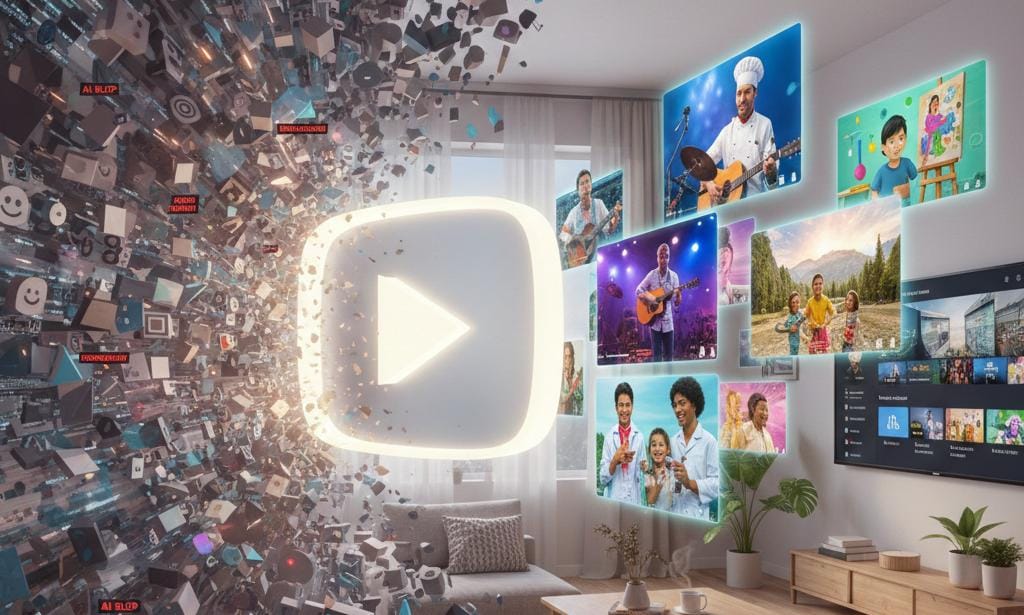
The year is 2026, and the digital world is at a breaking point. For the past two years, the internet has been besieged by what critics call "AI Slop"—mass-produced, low-effort, synthetic videos designed solely to game algorithms and harvest ad revenue. From nonsensical children’s animations to generic "Top 10" lists voiced by robotic clones, the noise has become deafening.
However, YouTube CEO Neal Mohan is not just watching from the sidelines. In a series of bold strategic moves finalized in early 2026, Mohan has unveiled a "Master Plan" to fundamentally rewire how the world’s largest video platform operates. The goal is clear: purge the "junk," empower the human creator, and transform YouTube into the definitive "New TV" for the AI era.
The Rise of the "Slop" Crisis
By late 2025, internal data and user sentiment converged on a troubling trend. Research suggested that up to 20% of recommendations were surfacing content that lacked human oversight. These "programmatic" videos—often generated by a single prompt and published without an ounce of editing—were beginning to erode the trust that YouTube spent two decades building.
"AI should be a tool for expression, not a replacement for the creator," Mohan stated in his 2026 annual letter. His plan marks the end of the "Wild West" era of synthetic media, ushering in a period of strict accountability and "radical transparency."
Pillar I: The Intelligence War on "Junk"
The first phase of the CEO’s plan involves fighting fire with fire. YouTube has overhauled its spam-fighting algorithms to specifically detect "low-quality, repetitive AI content." Unlike previous filters that looked for copyright strikes, the 2026 system—internally referred to as the Content Integrity Engine—uses multimodal AI to analyze "creative depth."
Human-in-the-Loop Verification: Videos that show signs of 100% automation are now flagged for demonetization. To stay eligible for the YouTube Partner Program, creators must demonstrate "Human Creative Contribution," such as original scriptwriting, personal commentary, or unique editing styles.
The Likeness Protection System: Building on the foundations of Content ID, YouTube now allows public figures and creators to "claim" their digital likeness. If an AI-generated video uses a creator's face or voice without permission, the system can automatically block it or redirect the revenue to the rightful owner.
Pillar II: Transparency as the New Gold Standard
The way we watch videos is changing because the labels we see are changing. By mid-2026, the "Altered Content" disclosure is no longer a hidden tag; it is a prominent part of the user interface.
YouTube now requires creators to disclose any "realistic altered or synthetic content." If a video features an AI-generated digital twin of the creator, it must be labeled as such. Failure to disclose doesn't just result in a strike; it can lead to a permanent "Shadow-Ban" from the recommendation engine. This move ensures that when a viewer watches a news report or a tutorial, they know exactly whether they are looking at a human or a hallucination.
Pillar III: YouTube as the "New TV"
Mohan’s plan isn't just about cleaning up the feed; it’s about where we watch. As of 2026, YouTube has officially surpassed traditional cable in daily viewership hours, specifically on the "Big Screen" (Connected TVs).
To solidify this, the platform is rolling out:
Customizable Multiview: Allowing viewers to watch up to four streams simultaneously—perfect for sports and breaking news.
Specialized Plans: Launching over 10 tailored subscription tiers for YouTube TV, focusing on niche interests like global sports or hyper-local news.
The "Shorts Timer": An industry-first parental control that allows parents to set a "Shorts limit" to zero, effectively disabling the infinite scroll for children and encouraging longer-form, educational viewing.
The 2026 Creator Economy: Quality Over Quantity
For years, the mantra for YouTube success was "upload daily." The Master Plan effectively kills this advice. The new algorithm rewards Retention and Originality over frequency. A high-quality, human-researched documentary that takes a month to produce is now significantly more likely to be promoted than 30 days of AI-generated "fact" videos.
"The most important creator on YouTube in five years is someone you’ve never heard of," Mohan noted. "And they are starting today, not by using AI to bypass the work, but by using AI to amplify their unique human voice."
How the Viewing Experience Changes for You
By the end of 2026, your "Home" feed will look remarkably different:
Less Clutter: The "Top 10" and "Motivational Quote" slideshows that used to plague the feed are being relegated to a "low-priority" bucket or removed entirely.
AI as a Companion: Features like the "Ask" tool allow you to chat with an AI about the video you are watching (e.g., "What are the ingredients mentioned at 4:02?"), making the experience interactive rather than passive.
Hyper-Personalization: The recommendation engine is moving away from "what you clicked on" to "what you actually valued," using AI to understand the nuance of human satisfaction.
The Human Renaissance
YouTube’s 2026 pivot is a high-stakes bet that the world is tired of "slop." By aggressively tackling junk content, Neal Mohan is attempting to future-proof the platform against a sea of mediocrity.
The Master Plan recognizes a fundamental truth: while AI can generate a billion videos in a second, it cannot replace the human connection, the lived experience, or the "it" factor that makes a creator a star. As we move toward 2027, YouTube is no longer just a video site; it is a curated, transparent, and high-fidelity entertainment ecosystem where the "human" is finally back in the driver's seat.
"The decisions we make today will shape the world for generations to come."