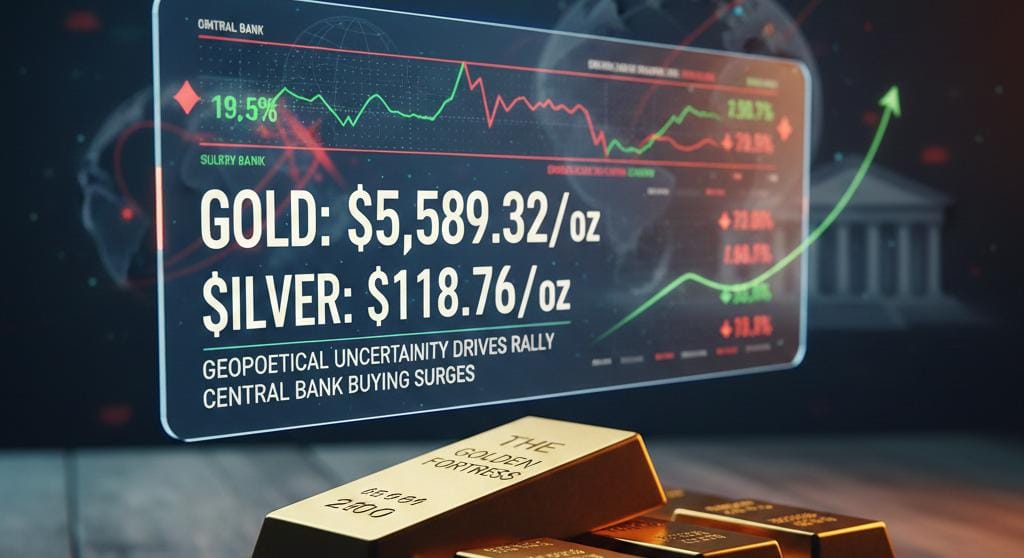
The global financial landscape of 2026 is being defined by a singular, glittering constant: the relentless ascent of gold. While traditional fiat currencies grapple with a "re-pricing of trust," gold has shattered historical glass ceilings, recently touching a breathtaking peak of nearly $5,600 per ounce. Though the market has seen sharp, tactical corrections—briefly dipping toward the $4,800–$4,900 range due to profit-taking and shifts in U.S. monetary leadership—the underlying narrative remains unshakable.
Gold is no longer just a "safe haven" for a rainy day; it has become the strategic cornerstone of a new global economic order. Driven by aggressive central bank accumulation and a geopolitical climate that feels increasingly like a "permanent crisis," the yellow metal is asserting its dominance as the ultimate hedge against a fracturing world.
The Geopolitical "Perfect Storm"
The primary engine behind gold's record-breaking run is the sheer density of global uncertainty. In 2026, the traditional rules of the global economy are being rewritten in real-time.
Trade Wars and Tariffs: The resurgence of aggressive "reciprocal tariffs" and protectionist trade policies has injected a high level of "debasement fear" into the markets. As nations use trade as a weapon, investors flee to assets that carry no counterparty risk.
Conflict and Brinkmanship: Tensions in the Middle East, particularly involving Iran, and strategic maneuvers over untapped territories like Greenland have kept a "war premium" permanently baked into gold prices. Every headline hinting at escalation acts as a fresh catalyst for a bullion rally.
The Fragility of Institutions: There is a growing sentiment among analysts that we are witnessing a fundamental loss of confidence in post-Cold War institutions. When trust in the stability of the dollar or the independence of central banks wavers, gold—the "stateless currency"—is the immediate beneficiary.
Central Banks: The New "Whales" of the Gold Market
Perhaps the most significant structural change in the gold market is the behavior of central banks. For decades, these institutions were net sellers; today, they are the most formidable buyers on the planet.
In the last year, emerging market central banks have aggressively diversified their reserves away from U.S. Treasuries and into physical gold. This "de-dollarization" trend is not merely political posturing; it is a calculated move to insulate national wealth from potential sanctions and currency volatility.
"The increase in gold reserves reflects a continued preference among central banks for diversifying into non-dollar reserve assets. It is a strategic pivot toward tangible security in an era of fiscal stress."
Even as prices hit record highs, the "buy the dip" mentality among central banks in China, India, and across the Global South has provided a massive floor for the market, preventing deeper corrections and fueling the next legs of the rally.
The "Warsh Effect" and Monetary Volatility
The recent volatility in early February 2026 highlights how sensitive the gold market has become to U.S. Federal Reserve policy. The nomination of Kevin Warsh as a potential Fed Chair sent shockwaves through the market. Known for a more hawkish stance on inflation, his potential leadership triggered a temporary rebound in the U.S. Dollar and a sharp "margin call" sell-off in precious metals.
However, many experts view this as a healthy "reset" of momentum. Technically, the broad uptrend remains intact. With support zones firmly established around $4,600–$4,800, the market is currently consolidating for what many major banks—including Deutsche Bank and Société Générale—predict could be a surge toward $6,000 per ounce by the end of 2026.
Silver: The "Gold on Steroids"
One cannot discuss the gold rally without mentioning its more volatile sibling: silver. In January 2026, silver outperformed nearly every major asset class, surging over 50% in a single month to reach $120 per ounce.
Silver’s rise is dual-powered:
Industrial Scarcity: The explosion of AI infrastructure, data centers, and the green energy transition has created a structural supply deficit.
Speculative Mania: As gold becomes too expensive for some retail investors, they pile into silver, driving parabolic moves that make it "gold on steroids."
Investment Outlook: Resilience Over Returns
For the modern investor, the message is clear: gold is the insurance policy that pays out when the world gets complicated. While retail "mania" and high-leverage trading can lead to brutal short-term corrections, the long-term fundamentals—debt expansion, geopolitical friction, and central bank demand—are more bullish than ever.
The New Normal for Bullion
As we move further into 2026, the "timeless allure" of gold has been replaced by a "timely necessity." We are living through a period where economic and geopolitical risks have become the new normal. In this environment, gold isn't just a commodity; it is a barometer of global anxiety and a fortress for capital preservation.
Whether you are a central banker looking to protect a nation's sovereignty or a retail investor looking to safeguard a retirement fund, the golden rally of 2026 is a reminder that in a world of digital complexity and political chaos, there is still no substitute for the weight of solid gold.
"The decisions we make today will shape the world for generations to come."