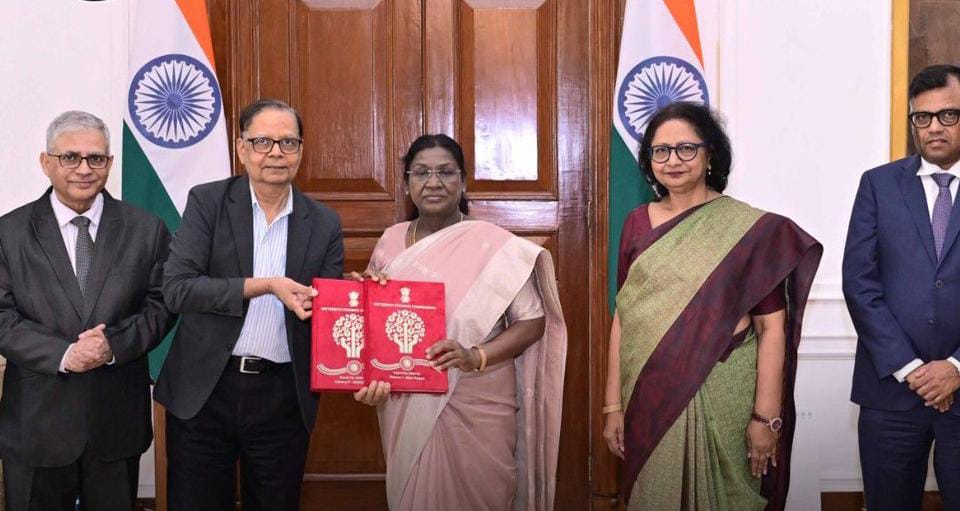
The unveiling of the Union Budget 2026-27 on February 1, 2026, marked more than just a new fiscal year; it inaugurated the "Panagariya Era" of Indian fiscal federalism. For the first time, the budget integrated the recommendations of the 16th Finance Commission (FC-16), led by Dr. Arvind Panagariya. Covering the award period from 2026 to 2031, this report has effectively rewritten the rules of engagement between the Centre and the States.
While the headline "41%" tax devolution suggests continuity, the underlying mechanics of how that money is distributed—and the strict conditions attached to it—reveal a fundamental shift toward performance-led governance.
The Vertical Dilemma: Why 41% is the New Ceiling
Since the 14th Finance Commission dramatically hiked the states' share of the divisible pool from 32% to 42% (later adjusted to 41% following the reorganization of Jammu & Kashmir), the Centre has argued that its fiscal space is shrinking. In the 2026 Budget, the FC-16 recommended retaining the 41% share, rejecting calls from several states to increase it to 50%.
The logic provided by the Commission is grounded in "deep fiscal decentralization." Data presented in the 2026 report shows that the post-transfer revenue balance has shifted from 43:57 in favor of the Centre during the 5th FC to 33:67 in favor of the States under the 15th FC. With the Centre shouldering the burden of national security, massive infrastructure capex (projected at ₹12.4 trillion for FY27), and interest payments on a national debt still recovering from pandemic-era highs, the 41% mark has been established as a pragmatically high floor.
Horizontal Devolution: The Efficiency Revolution
The real "fireworks" in the 2026 Budget discussion involve the horizontal devolution formula—how the 41% is split among the 28 states. The FC-16 has introduced a historic new criterion: Contribution to India’s GDP, assigned a 10% weight.
This new 10% weight for GDP contribution is a direct response to the long-standing grievances of high-growth southern states like Karnataka, Tamil Nadu, and Telangana. By rewarding economic output, the Commission has created an "efficiency-equity complementarity." However, this has come at a cost to the "Hindi Heartland." States like Uttar Pradesh, Bihar, and Madhya Pradesh have seen their shares decrease by 11 to 50 basis points, reflecting a move away from purely "gap-filling" transfers.
The End of the Safety Net: Discontinuing Revenue Deficit Grants
Perhaps the most controversial move in the 2026 fiscal roadmap is the discontinuation of Revenue Deficit Grants (RDG). For decades, RDGs under Article 275(1) acted as a "top-up" for states that remained in deficit even after tax devolution.
The 16th Finance Commission argued that these grants create a "perverse incentive," discouraging states from undertaking difficult reforms like rationalizing subsidies or improving tax administration. This has hit hill states and highly indebted states particularly hard:
Himachal Pradesh: Losing an expected ₹50,000 crore over the next five years.
West Bengal: Now facing an ₹8.15 lakh crore debt with no "safety net" grant to cushion revenue expenditure.
The 2026 Budget reinforces this by demanding that states bring off-budget borrowings onto their balance sheets, ensuring that the 3% GSDP fiscal deficit limit is a hard cap rather than a suggestion.
Urban Governance and the "Middle-City" Focus
A standout feature of the 2026 Budget discussions is the massive hike in Local Body Grants, totaling ₹7.9 lakh crore—2.2 times higher than the previous period. The focus has shifted toward mid-sized cities and the "urban fringes."
The Commission has proposed:
Performance-linked Grants: 40% of local body funds are now tied to measurable outcomes in property tax collection and digital governance.
GIS-Based Property Tax: Mandatory adoption of digital property registers linked to city master plans.
The "Peri-Urban" Integration: Funding to bring rapidly urbanizing rural areas into municipal frameworks before they become chaotic "census towns."
Critical Challenges and the Road Ahead
Despite the optimism of a "Viksit Bharat" (Developed India), three major tensions remain at the heart of the 2026-31 fiscal period:
The Power Sector Trap: The FC-16 report flagged that 40% of State Public Sector Enterprises (SPSEs) are loss-making, led by power discoms. The Commission has recommended a controversial "privatization push," suggesting that states park old debt in Special Purpose Vehicles (SPVs) to make discoms attractive to private investors.
The Subsidy War: The Commission has called for "sunset clauses" on non-merit subsidies. States like Telangana, with high per-capita subsidy spending (₹16,460), are now under pressure to choose between political populist schemes and fiscal sustainability.
Climate & Disasters: A new ₹2.04 lakh crore disaster management corpus has been set up. Crucially, "heatwaves and lightning" have been added as notified disasters, reflecting the changing climate reality of 2026.
A New Compact for 2031
The 2026 Budget, guided by the 16th Finance Commission, represents a "tough love" approach to federalism. By rewarding efficiency through GDP contribution and punishing fiscal profligacy by ending revenue deficit grants, the Centre is betting that states will transform into competitive economic engines rather than administrative dependents.
As we move toward 2031, the success of this blueprint will depend on whether "middle-income" states can leverage their new incentives to catch up, or if the withdrawal of the safety net will widen the gap between India’s economic leaders and its laggards.
"The decisions we make today will shape the world for generations to come."