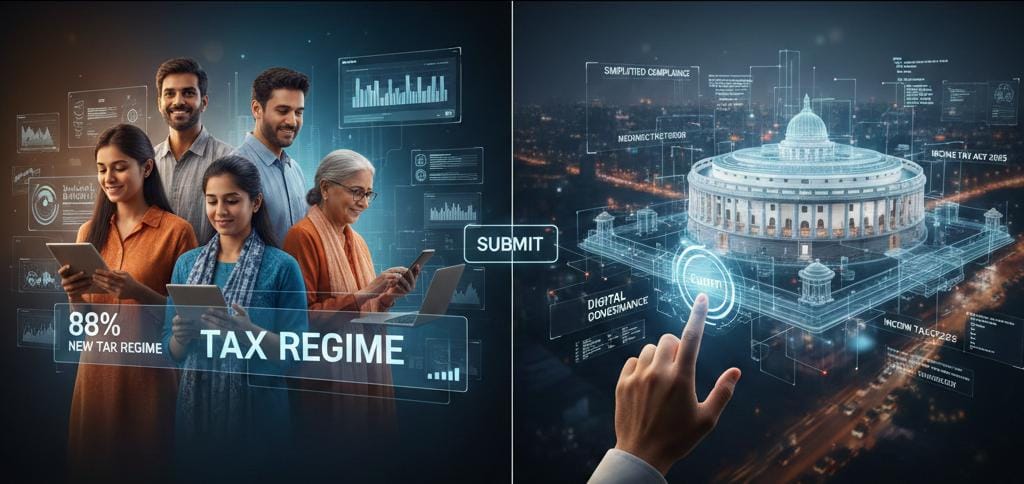
The Indian fiscal landscape is undergoing a seismic shift. In a landmark announcement following the Union Budget 2026, the Central Board of Direct Taxes (CBDT) revealed that approximately 88% of individual taxpayers have now migrated to the New Tax Regime. This is not merely a statistical milestone; it represents a fundamental change in how the average Indian interacts with the state's coffers.
For decades, tax filing in India was a complex ritual of gathering investment proofs, calculating House Rent Allowance (HRA), and maximizing Section 80C deductions. Today, the narrative has pivoted. By choosing the New Tax Regime, nearly nine out of ten taxpayers have opted for lower rates and a "no-hassle" experience over the dense thicket of exemptions that defined the old era. This article explores the drivers behind this mass adoption and the government's ambitious roadmap to streamline compliance.
The Anatomy of the Migration: Why the New Regime Won
The journey to 88% adoption didn’t happen overnight. It was the result of consistent "nudging" by the Ministry of Finance, culminating in the strategic tweaks seen in the 2025 and 2026 budgets.
1. The "Zero Tax" Sweet Spot
The most compelling driver has been the threshold for zero tax liability. Under the current structure, individuals earning up to ₹12 lakh can effectively pay zero tax after accounting for the standard deduction and the Section 87A rebate. For the vast majority of India’s middle class, the math is simple: the tax saved by exemptions in the old regime rarely exceeds the benefit of the lower slabs and higher rebate in the new one.
2. Liquidity Over Locked-in Savings
The Old Tax Regime forced taxpayers to lock their money into long-term instruments like the Public Provident Fund (PPF) or Equity Linked Savings Schemes (ELSS) to save tax. While this promoted savings, it often constrained monthly cash flow. The New Tax Regime returns that "disposable income" to the taxpayer. In a post-pandemic economy where immediate liquidity is valued, the freedom to spend or invest without tax-mandated restrictions has proven highly attractive.
3. Administrative Ease
The CBDT Chairman, Ravi Agrawal, noted that for presumptive tax cases—mostly small businesses and professionals—the adoption rate is even higher at 97%. For these taxpayers, the New Regime eliminates the need to maintain exhaustive records of personal investments, reducing the "compliance cost" of hiring accountants just to find ways to save a few thousand rupees.
Streamlining the Rules: The 2026 Compliance Overhaul
The 88% adoption rate is only one side of the coin. The other side is the government’s aggressive push to make the process of being a taxpayer less punitive and more intuitive. The Union Budget 2026 introduced several "ease of living" reforms that aim to replace administrative friction with digital-first solutions.
1. The New Income Tax Act, 2025
Set to take effect from April 1, 2026, this legislative overhaul aims to replace the aging Income Tax Act of 1961. The goal is to provide a "cleaner, more accessible framework" with simplified language. The government has promised revamped ITR forms that are shorter and pre-filled with more accurate data from the Annual Information Statement (AIS).
2. Staggered Deadlines and Extended Revisions
To avoid the last-minute "server crash" anxiety every July, the government has introduced staggered filing:
ITR-1 and ITR-2 (Individuals): Deadline remains July 31.
Non-audit business cases/Trusts: Deadline extended to August 31.
Furthermore, the window to file revised returns has been extended from December 31 to March 31, acknowledging that taxpayers need more time to correct genuine errors without facing immediate litigation.
3. Rule-Based Automation for Small Taxpayers
In a significant move toward "faceless" governance, the Budget 2026 proposed a rule-based automated process for issuing Nil or Lower TDS certificates. Previously, small taxpayers (like pensioners) had to apply to an Assessing Officer—a process often fraught with delays. Now, a system-driven approval replaces human discretion, ensuring that liquidity isn't trapped in the tax-refund cycle.
4. Simplifying TDS on Property and Remittances
The government has also addressed specific "pain points":
NRI Property Sales: Resident buyers purchasing property from Non-Residents can now deposit TDS using a PAN-based challan, eliminating the tedious requirement of obtaining a Tax Deduction and Collection Account Number (TAN).
Overseas Remittances: The Tax Collection at Source (TCS) on overseas tour packages and medical/educational remittances has been rationalized to a flat 2%, preventing large sums of money from being blocked until the next filing season.
The Road Ahead: From "Tax Enforcement" to "Tax Service"
The shift toward the New Tax Regime and simplified compliance signals a change in the state's philosophy. By moving away from a system that rewards specific investment behaviors (like insurance or home loans), the government is treating the citizen as a mature economic actor capable of making their own financial decisions.
However, challenges remain. While 88% have moved, the remaining 12% often include high-net-worth individuals or those with significant home loans for whom the Old Regime still offers better math. The government has wisely ruled out a "sunset clause" for the Old Regime for now, maintaining a choice for the taxpayer.
Ultimately, the goal is a "Viksit Bharat" where the tax-to-GDP ratio increases not through higher rates, but through a broader base and voluntary compliance fueled by trust. As the New Income Tax Act 2025 rolls out, the emphasis will be on reducing litigation and making the tax department feel less like a "collector" and more like a "service provider."
The 88% adoption rate is a vote of confidence in simplicity. For the individual, it means less time spent on spreadsheets and more time focused on earning. For the government, it means a streamlined, digital-first revenue stream. As we approach April 2026, the era of "Taxation by Complication" is officially drawing to a close.
"The decisions we make today will shape the world for generations to come."