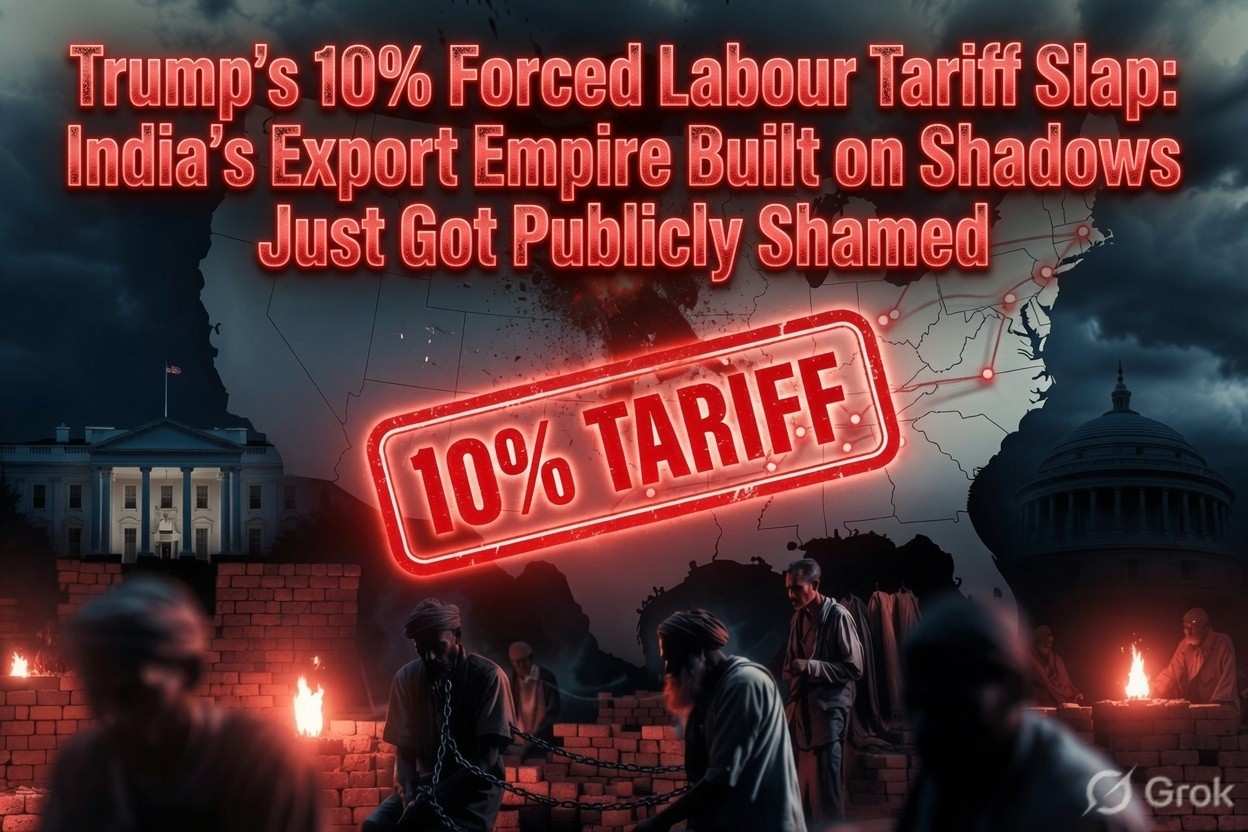
Donald Trump’s administration has just delivered a calculated blow. On 23 July 2026, the United States Trade Representative imposed a 10% additional tariff on goods from India and 16 other economies under Section 301 of the Trade Act of 1974. The stated ground: failure to impose and effectively enforce a prohibition on the importation of goods produced with forced labour. The measure took effect the next day as a temporary global 10% levy expired, covering roughly 99.4% of US imports.
India landed in the lower 10% bracket alongside Bangladesh, Pakistan, Sri Lanka, Canada, Mexico, the United Kingdom and several others. China and dozens more face 12.5%. This was not the original plan. In June the USTR had proposed 12.5% for India. The reduction came only after New Delhi hastily amended its Foreign Trade Policy in mid-July to prohibit imports of goods made wholly or in part with forced labour. The Directorate General of Foreign Trade notified the change, adding a new paragraph that empowers the government to ban such products after inquiry.
The sequence reveals everything. An investigation launched on 12 March 2026 examined 60 economies. Public hearings followed in April and again in early July. India submitted arguments, industry bodies protested, and officials insisted the issue belonged in bilateral trade talks. Yet the policy amendment arrived only when the threat of a higher rate became concrete. That is not leadership. That is damage control under pressure from a foreign capital.
The numbers that hang over this episode are damning. Walk Free’s Global Slavery Index estimates 11 million people in modern slavery in India—the highest absolute figure of any country. Forced labour thrives in brick kilns, agriculture, garment supply chains, domestic work and informal construction. Constitutional prohibitions and labour laws exist on paper. Enforcement remains selective, under-resourced and frequently compromised by the same political-business networks that celebrate record exports. When the United States, which has maintained its own forced-labour import ban for nearly a century, decided to weaponise the gap, India’s governing machinery moved only far enough to secure the cheaper tariff rate.
This is the true face of the system. Export figures are defended as national pride while the human cost is treated as an inconvenient externality. Bilateral trade with the United States exceeds $140 billion, with India shipping nearly $87 billion in goods. Those shipments now carry a permanent surcharge justified by Washington as both a human-rights correction and a response to distortive trade practices. American officials openly state that decades of moral suasion failed and that tariffs will force trading partners to act. India responded by writing a new rule into the Foreign Trade Policy rather than demonstrating years of rigorous, transparent enforcement that would have made the tariff unnecessary.
The deeper damage is structural. By treating labour protections as a negotiating chip to be adjusted under external threat, the government signals to every exporter and every district administration that the real priority is market access, not the elimination of coercion. Workers who cannot leave debt bondage, children pulled into informal production, and migrants trapped in seasonal cycles remain invisible until a foreign trade office notices. The same system that claims to speak for the poor then turns around and asks those same workers to accept higher living costs or lost orders when tariffs raise the price of Indian goods in the world’s largest market.
Critics of the US action call it protectionism dressed as principle. That charge has merit. The tariffs maintain a floor on almost all imports after earlier reciprocal duties were struck down by the Supreme Court. Exemptions exist for critical raw materials, certain foods, and goods already covered by national-security measures. Yet the selective nature of the critique does not erase India’s own record. A nation that ranks first in the absolute number of people in modern slavery cannot claim moral high ground when its trade policy is rewritten only after a tariff proposal lands on the table.
The coming months will test whether the July amendment is theatre or substance. Enforcement mechanisms, public lists of banned products, independent audits of high-risk sectors, and transparent data on investigations will decide. So far the pattern is clear: the system reacts to external power rather than to the daily reality of millions of its own citizens. That pattern is what continues to hollow out the nation’s claim to dignity in the global economy.
"The decisions we make today will shape the world for generations to come."