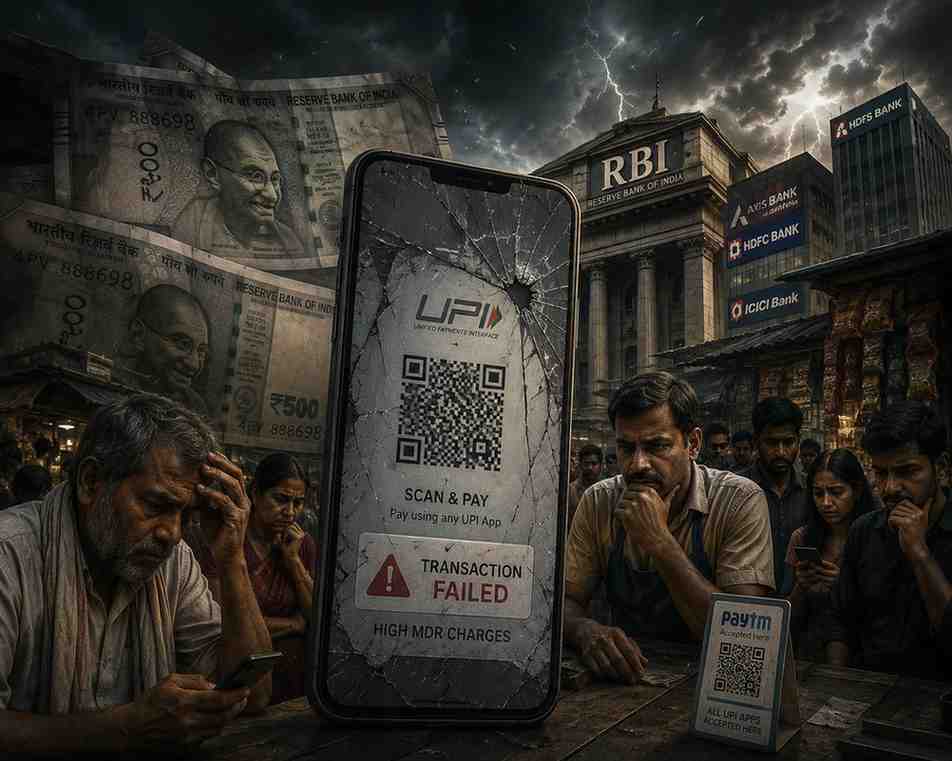
India’s most celebrated digital success story has just been quietly undermined. On 6 August 2026, the Lok Sabha cleared the Taxation and Other Laws (Amendment) Bill, 2026 by voice vote amid opposition sloganeering and zero substantive debate. Buried inside this legislation is a surgical amendment to Section 10A of the Payment and Settlement Systems Act, 2007. The change removes the hard legal prohibition that had forced banks and payment service providers to keep UPI and RuPay transactions free of merchant discount rates since January 2020.
What existed as a statutory firewall is now reduced to an executive favour. The government can simply issue a notification specifying which electronic payment modes remain exempt. Modes not notified can lawfully attract charges. This is not a minor procedural tweak. It is the deliberate dismantling of the legal foundation of the zero-MDR regime that turned UPI into the world’s largest real-time payment system.
The official line is carefully crafted. Consumers will face no direct charges. Person-to-person transfers will stay free. Any future MDR, we are told, will be “nominal,” threshold-based, and limited to a small set of larger merchants. The UPI and Services Steering Committee under NPCI will decide the details once the bill completes its parliamentary journey. The Ministry of Finance’s 8 August press release insists the amendment is merely an “enabling provision” required for long-term sustainability, technological upgrades, cybersecurity, and resilience against emerging risks.
These assurances ring hollow when measured against the method and the history. The zero-MDR policy was not an accident. It was a deliberate political choice announced in the 2019 Budget and locked into law from January 2020. Banks and payment companies were told to absorb the cost because the social and economic returns of mass digital adoption outweighed private revenue. The system delivered. UPI processed 2,366 crore transactions worth ₹29.9 lakh crore in July 2026 alone. Small merchants, street vendors, and ordinary citizens adopted it because it was free and frictionless. Financial inclusion numbers soared precisely because the government forced the infrastructure providers to treat access as a public good rather than a profit centre.
That public-good character is now being reversed without open parliamentary scrutiny. The bill was introduced on 4 August and rushed through the lower house two days later with no discussion of consequences for the informal economy, rural users, or the very merchants who made UPI ubiquitous. Handing the power to an executive notification means future decisions on charges can be made without returning to the legislature. This is governance by stealth dressed up as technical reform.
The practical effects are already predictable even if the exact rates remain undecided. Large merchants facing even a 5–7 basis point charge on high-value transactions will factor the cost into pricing. Small and medium businesses that sit just above any turnover threshold will feel pressure. Once the principle of free merchant acceptance is broken, the political and commercial incentive to expand the chargeable base grows. History of payment systems globally shows that temporary or limited fees rarely stay limited. Costs migrate. Consumers eventually pay, either through higher prices or through reduced acceptance of the free mode.
The deeper damage is institutional. UPI succeeded because the state subordinated private rent-seeking to national digital ambition. By reopening the door to MDR and placing the decision solely in the hands of the executive and an industry-heavy committee, the government signals that the era of treating digital payments as public infrastructure is over. Banks and large fintechs gain a path to monetise volume that was built on public policy and public trust. The common user and the kirana store lose the certainty that the system would remain free.
Claims of sustainability ring especially self-serving. The same government that celebrates UPI’s global export and its role in financial inclusion now argues that the model which delivered those outcomes is unsustainable without private charges. If the infrastructure requires continuous investment, the honest route was transparent budgetary support or a carefully debated, legislated framework with clear protections for small merchants and users. Instead, the legal shield was removed first and the details left for later administrative decision. That sequence reveals priorities more clearly than any press release.
India’s digital payments revolution was never just about technology. It was about removing friction for hundreds of millions who had been excluded from formal finance. The amendment passed this week does not immediately impose fees, but it ends the legal guarantee that made the free model possible. Once that guarantee is gone, the balance of power shifts permanently toward those who can lobby for revenue and away from those who simply need to pay and get paid without cost.
The system that claimed to serve the nation has begun serving its own sustainability narrative. The price will ultimately be paid by the people who trusted the promise of free, frictionless digital money.
Official Sources
- Press Information Bureau, Ministry of Finance release dated 8 August 2026 on amendment to the Payment and Settlement Systems Act
- Taxation and Other Laws (Amendment) Bill, 2026 as passed by Lok Sabha on 6 August 2026
- Text of the amendment to Section 10A of the Payment and Settlement Systems Act, 2007
Disclaimer: This article discusses legislative and policy developments that may affect digital payment costs and the broader payments ecosystem. It is based on publicly available parliamentary and government information as of early August 2026. Readers should verify the final form of the law after both Houses of Parliament and any subsequent notifications before making financial or business decisions.
"The decisions we make today will shape the world for generations to come."