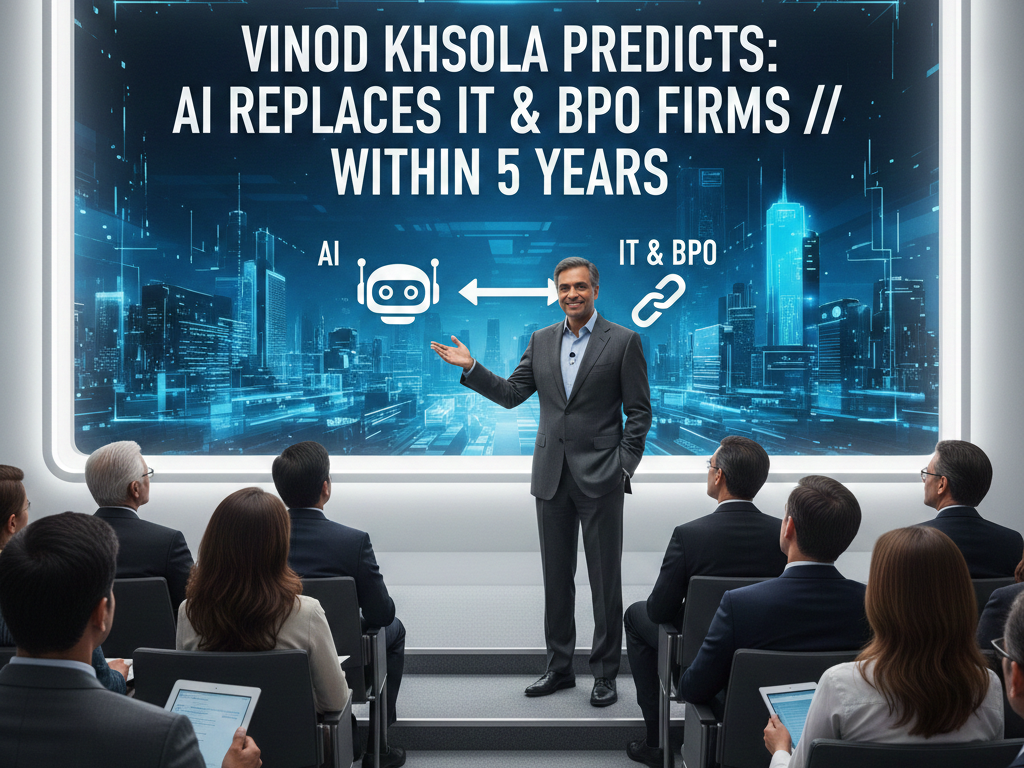
Vinod Khosla, the billionaire venture capitalist, Sun Microsystems co-founder, and founder of Khosla Ventures, issued a bold prediction ahead of the India AI Impact Summit 2026: artificial intelligence will cause India's IT services and BPO sectors to "almost completely disappear" within five years. In an exclusive interview with Hindustan Times on February 15, 2026—just one day before the summit kicks off in New Delhi—Khosla argued that AI's rapid advance toward human-level intelligence in economically valuable tasks represents a fundamental economic shift unlike any prior technology wave.
AI's Unique Disruption: Replicating Human Cognition
Khosla distinguished this AI era from past innovations like the internet or smartphones, which created new business models but did not directly replicate cognitive labor. "What’s interesting about AI is that previous technologies helped do various jobs. AI is creating human intelligence, where it’s very likely in the next five years, AI will be better than most humans at most things," he told Hindustan Times . He specified that fields like coding, customer support, system integration, and back-office operations face immediate obsolescence, while creative pursuits such as art, literature, and music remain safer for now.
India's IT and BPO industries, employing millions and contributing significantly to GDP, stand particularly vulnerable. Khosla noted AI can deliver these services at one-fifth the cost, making labor-arbitrage models unsustainable. This echoes his prior warnings, including a September 2025 Startup Policy Forum event where he advised founders that AI enables companies to "operate with half the number of people," and earlier forecasts of AI handling 80% of economically viable jobs soon.
Wider Professions on the Chopping Block
The transformation extends far beyond outsourcing. Khosla predicted that expertise-driven fields—accounting, law, medicine, chip design, architecture, and more—will see deep disruption within 10-15 years as AI outperforms humans in specialized tasks . "AI systems are rapidly approaching a stage where they can outperform humans," he emphasized, urging proactive adaptation.
For India, with its 250 million young people entering the workforce, the implications are profound. Khosla called for a pivot from traditional services to exporting AI-native products and platforms .
Democratization: AI as India's Great Equalizer
Amid the disruption, Khosla highlighted AI's upside: universal access to elite services at near-zero cost. "AI can make a doctor available to every Indian for almost no cost," he said, extending the vision to education, legal aid, and beyond.
Productivity gains could slash inflation and reshape economies, but he cautioned that without policy-driven redistribution—such as universal basic income—inequality could surge .He referenced his firm's backing of Sarvam AI, an Indian model-builder, as evidence of the country's potential. "India does have sufficient talent to develop these technologies... There will be applications of AI that India should absolutely have a serious effort on," Khosla stated .
Call to Action for India
Khosla urged India to build sovereign AI capabilities amid US-China dominance, criticizing policies like President Donald Trump's immigration restrictions that hinder talent flows . Success demands moving beyond large language models to next-gen AI, alongside rapid reskilling.
Summit Context
The India AI Impact Summit 2026, running February 16-20 at Bharat Mandapam in New Delhi, draws global leaders like Google CEO Sundar Pichai and Nvidia CEO Jensen Huang . Hosted by the Government of India, it spotlights AI's role in national strategy, amplifying Khosla's timely wake-up call . As the event unfolds today, February 16, 2026, his words challenge policymakers, businesses, and educators to reimagine India's future.
"The decisions we make today will shape the world for generations to come."