Monday did not invent fear. It priced it.
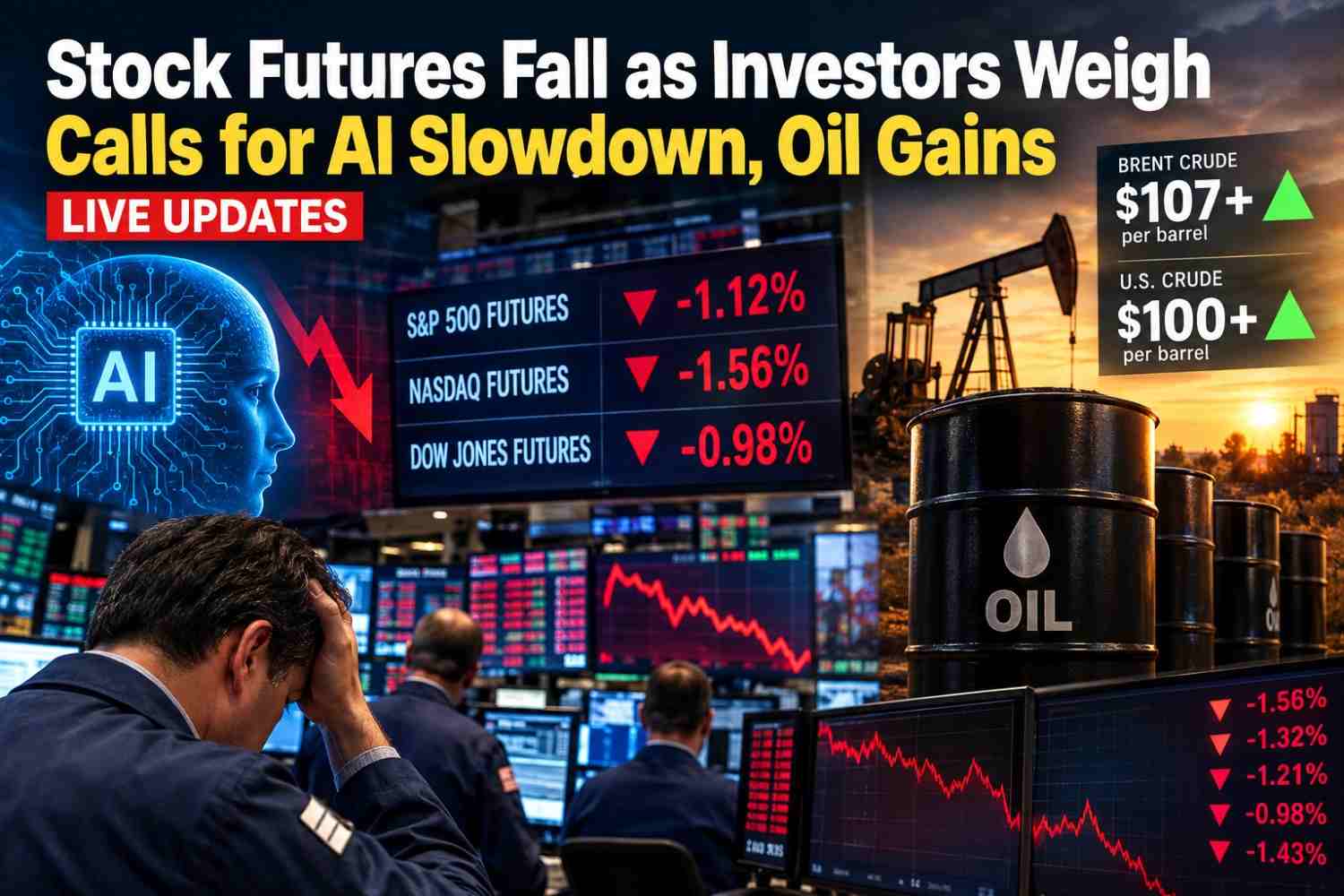
The Dow Jones Industrial Average finished 14 September 2026 down 151.66 points, or 0.29 percent, at 52,421.63. The S&P 500 dropped 36.93 points, or 0.48 percent, to 7,620.05. The Nasdaq Composite lost 145.25 points, or 0.55 percent, to 26,187.79. The Nasdaq 100 was weaker still, off about 0.8 percent after an opening cut that ran past 1 percent. Those are not crash prints. They are the sound of a market that had treated every new model as a purchase order for silicon, then heard the vendors ask for a speed limit.
The order came from the labs, not the Fed. On Saturday Anthropic chief Dario Amodei published an essay arguing that companies must slow the pace at which they improve model capabilities. OpenAI’s Sam Altman and xAI’s Elon Musk said they agreed — a sentence the tape is not used to reading. Altman separately called an OpenAI listing this year ill-advised. A former lab researcher’s resignation note, that builders privately talk of systems that could kill everyone by the decade’s end, did the weekend rounds. By Monday Asia had already voted. South Korea’s Kospi sank 3.3 percent as SK Hynix and Samsung Electronics were hit. SoftBank, the great OpenAI cheque-writer, dropped more than 10 percent in Tokyo. ASML, Europe’s most valuable industrial, was cut with the rest of the toolmakers.
New York simply finished the job. The PHLX semiconductor index fell on the order of 5 percent. Nvidia, still the gravity well of the AI trade, dropped about 3 percent and was the largest single weight on both the S&P 500 and the Nasdaq. AMD and Intel were worse, down around 5 percent. Marvell and Micron were worse again. Memory and foundry names paid first because a slower model race is a slower rack race: fewer accelerators, fewer HBM stacks, fewer tools. Software and cybersecurity did the opposite. CrowdStrike and the broader software basket caught a bid on the idea that a more dangerous machine is a bigger security budget. That is not a moral awakening. That is rotation.
A second blade cut the same session. Brent had printed above $108 before settling about 1 percent higher near $105.68 after strikes on Saudi energy kit and more trouble on Middle East shipping. The 10-year Treasury yield tagged 5 percent for the first time since 2023. This week’s Federal Reserve meeting is priced for a hike. Expensive oil plus a hawkish tape is the old recipe for knocking growth stocks off a ledge. Chip stocks were already standing on that ledge.
Donald Trump called the safety chorus a “sick conspiracy” against AI and data centers and said the only guardrail required was a “STRONG AND SMART (High IQ!) PRESIDENT.” Markets bounced off the lows after he also talked up an Iran deal. That is the American version of policy: a Truth Social post as circuit breaker. It does not write a statute. It does not fund a grid. It tells capital that the White House would rather win the race than referee it.
India will open in a few hours to that hangover. Every “AI superpower” slide deck out of Delhi assumes the same curve Wall Street just questioned: endless capex, endless tokens, endless chips. The republic still cannot keep a PF claim moving or a municipal tap honest, yet ministers pose in front of GPU clusters they do not own and data-center parks that will drink rivers and power the country does not generate. Foreign funds that fattened mid-caps on the Nasdaq’s AI multiple will now mark those same names to a slower story. The worker who was sold Digital India last week as a free UPI scan under ₹2,000 will be told this week that the future is a language model. Both promises travel the same road: announce the miracle, socialise the cost, privatise the upside.
None of this proves the AI build is over. Hyperscalers have not cancelled a campus on an essay. Nvidia’s data-center run-rate was not rewritten in 3,800 words. A coordinated slowdown that China refuses to join is a press release, not a treaty. Traders said as much by buying software while selling the picks and shovels. The honest read is narrower. For two years the index was a leveraged bet that capability would rise every quarter and that every rise would ship another warehouse of boards. On Monday the people who write the models said the next quarter might be smaller on purpose. The tape believed them for a session.
Watch the Fed statement, the next oil spike, and whether any lab actually delays a training run. Until a purchase order slips, this is a warning priced in semiconductors, not a funeral. Treat it as a reminder that a market built on one story can lose a week of that story between Saturday’s essay and Monday’s close.
Disclaimer
Index levels and stock moves are from Monday, 14 September 2026 session reports and may be revised. This is news and analysis, not investment advice. Equities, oil and rates can move sharply. Do your own research.
Official sources
Reuters — “Wall St falls as AI anxiety batters Nvidia, chipmakers” / close wrap, 14 September 2026 (Dow 52,421.63 −0.29%; S&P 500 7,620.05 −0.48%; Nasdaq Composite 26,187.79 −0.55%)
Reuters — “Global AI stocks fall as industry chiefs call for slowing development,” 14 September 2026
Dario Amodei essay and related interviews, 12–13 September 2026; OpenAI / xAI public comments on pacing
Bloomberg / market wraps — oil, 10-year yield at 5%, Fed week backdrop
"The decisions we make today will shape the world for generations to come."