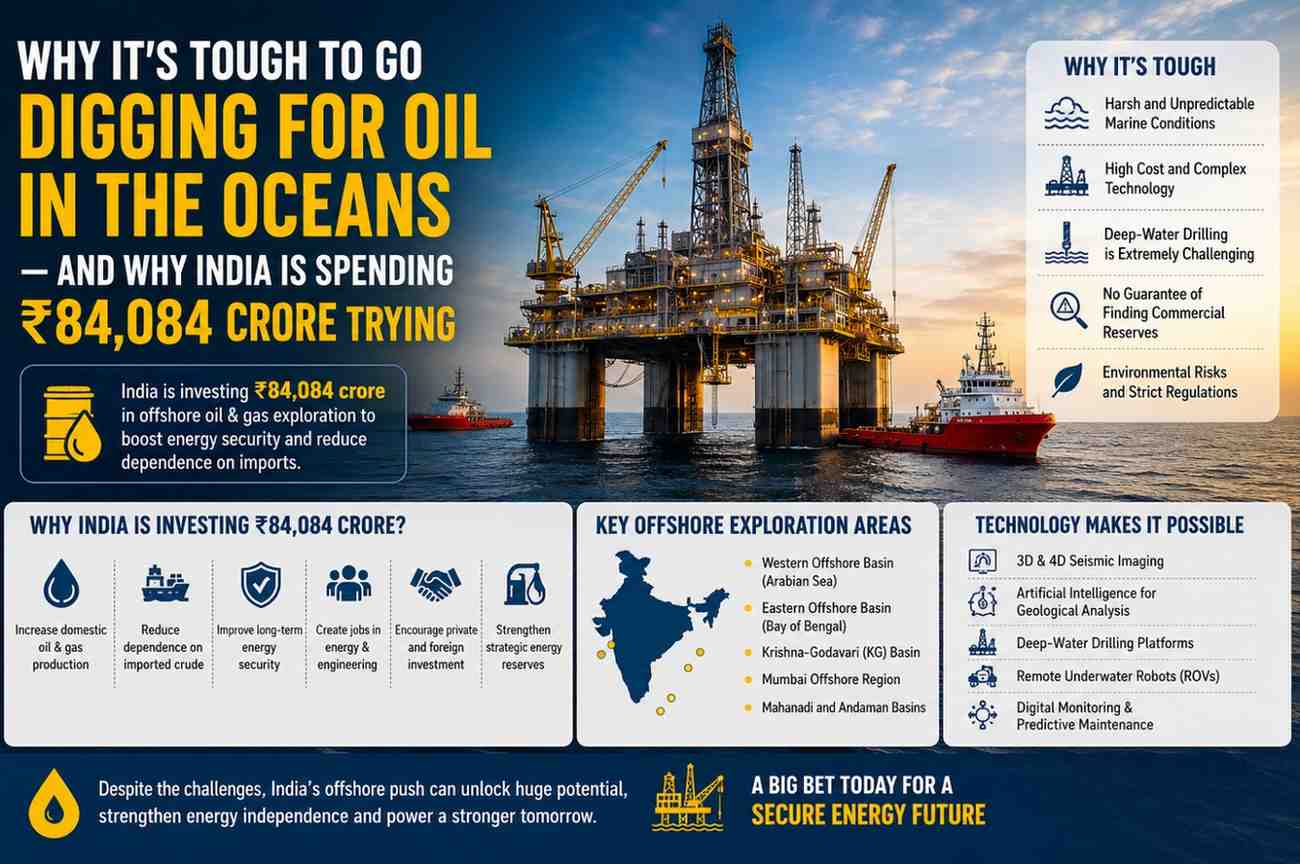
India is taking a bold step to strengthen its energy future by investing ₹84,084 crore in offshore oil and gas exploration and production. While the oceans hold vast reserves of crude oil and natural gas, extracting these resources is one of the most difficult and expensive engineering challenges in the world.
As India's demand for energy continues to rise due to rapid industrial growth, urbanization, and increasing vehicle ownership, the country is looking beyond onshore fields to tap the enormous potential hidden beneath the seabed.
Why Is Offshore Oil Exploration So Difficult?
Finding oil beneath the ocean is far more complex than drilling on land. Before any drilling begins, scientists conduct extensive geological and seismic surveys to identify possible oil and gas deposits. Even after years of research, there is no guarantee that commercially viable reserves will be found.
Once a promising location is identified, companies must build or deploy sophisticated offshore drilling rigs capable of operating in harsh marine environments. These platforms face powerful waves, cyclones, high pressure, corrosive saltwater, and deep-sea conditions that require cutting-edge technology and constant maintenance.
In deep-water fields, wells can extend several kilometers below the seabed, making drilling operations extremely challenging. Specialized equipment, remotely operated underwater vehicles (ROVs), and advanced monitoring systems are required to ensure safety and efficiency.
Why Is India Investing ₹84,084 Crore?
India currently imports nearly 85% of its crude oil requirements, making the country highly dependent on global energy markets. Fluctuations in international oil prices and geopolitical tensions often impact India's import bill and inflation.
The massive investment aims to:
1. Increase domestic oil and natural gas production.
2 .Reduce dependence on imported crude oil.
3. Improve India's long-term energy security.
4. Create employment in the energy and engineering sectors.
5. Encourage private and foreign investment in exploration.
6. Strengthen the country's strategic energy reserves.
The government believes that expanding offshore exploration will help meet future energy demand while supporting economic growth.
Offshore Exploration Areas
India's offshore exploration activities are concentrated in several major basins, including:
1.Western Offshore Basin (Arabian Sea)
2.Eastern Offshore Basin (Bay of Bengal)
3.Krishna-Godavari (KG) Basin
4.Mumbai Offshore Region
5.Mahanadi and Andaman Basins
These regions are believed to contain significant untapped hydrocarbon resources.
Technology Plays a Crucial Role
1.Modern offshore drilling relies heavily on advanced technologies such as:
2.3D and 4D seismic imaging
3.Artificial Intelligence for geological analysis
4.Automated drilling systems
5.Deep-water drilling platforms
6.Remote underwater robots
7.Digital monitoring and predictive maintenance
These innovations improve exploration success rates while enhancing operational safety.
Environmental Challenges
Offshore drilling also raises environmental concerns. Oil spills can damage marine ecosystems, fisheries, and coastal communities. Therefore, companies must comply with strict environmental regulations, emergency response plans, and international safety standards.
Balancing energy development with environmental protection remains a key challenge for governments and energy companies worldwide.
India's Energy Future
Despite the rapid growth of renewable energy sources like solar and wind, oil and natural gas will continue to play an important role in India's energy mix for years to come. Transportation, aviation, shipping, petrochemicals, and several industries still rely heavily on fossil fuels.
By investing ₹84,084 crore in offshore exploration, India aims to strengthen domestic energy production, reduce import dependence, and build a more secure and resilient energy system. Although exploring beneath the oceans is costly and technically demanding, successful discoveries could deliver significant economic and strategic benefits for the country over the coming decades.
"The decisions we make today will shape the world for generations to come."