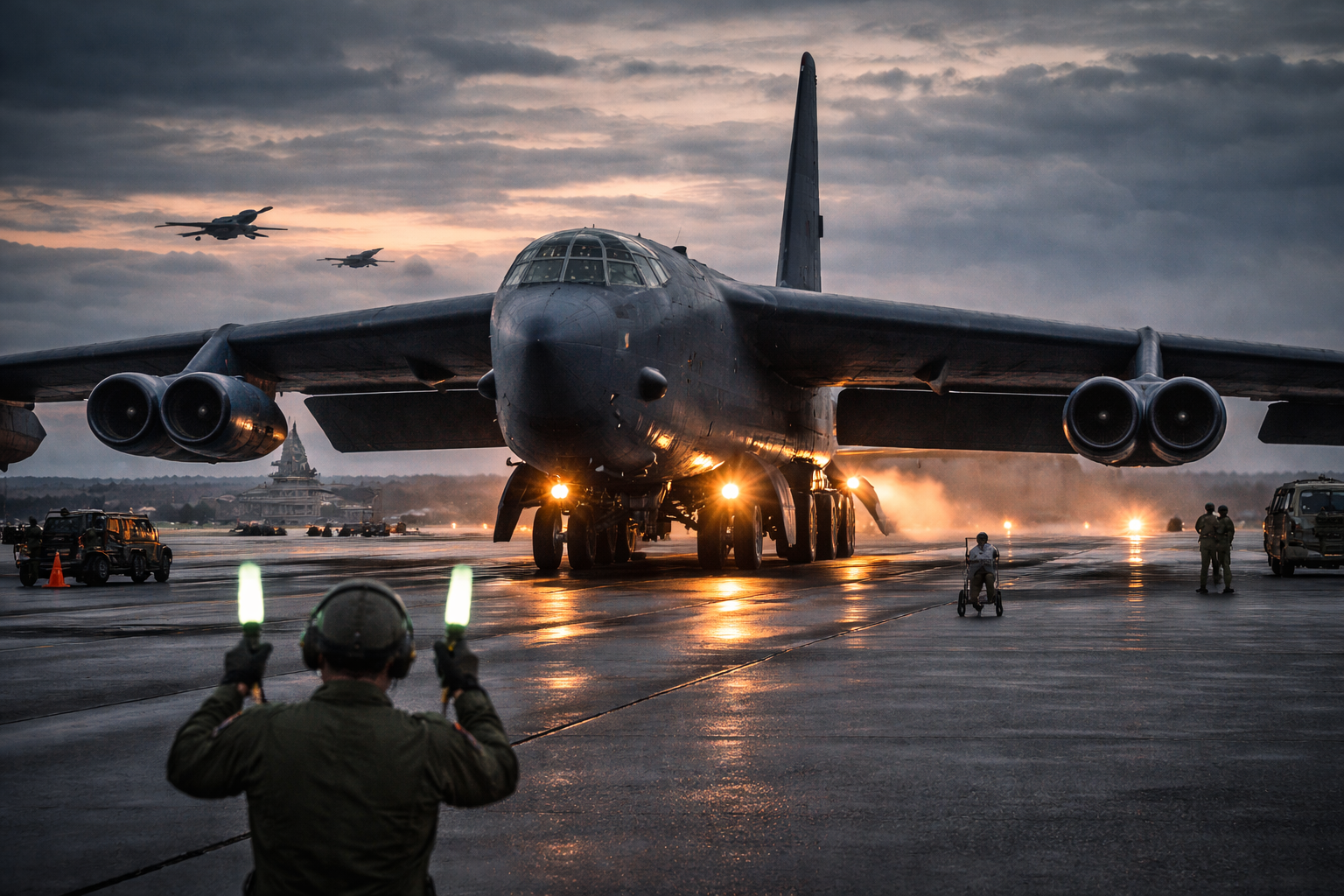
The United States has once again turned to one of the most iconic aircraft in its arsenal—the B-52 Stratofortress—as part of a major air campaign targeting Iranian military infrastructure. The bomber, first introduced in the early Cold War era, continues to demonstrate its enduring role in modern warfare.
According to U.S. military officials, Operation Epic Fury, launched on February 28, 2026, involves coordinated air operations aimed at weakening Iran’s military command structure and missile capabilities. The operation was initiated under the direction of President Donald Trump and is being carried out by the United States Central Command (CENTCOM).
In the early stages of the campaign, American strategic bombers conducted large-scale precision strikes on Iranian ballistic missile facilities, command and control centers, and other strategic targets. The opening phase reportedly included intense bombardment operations during the first 100 hours, targeting infrastructure believed to be linked to Iran’s missile network.
The B-52 Stratofortress played a major role in these operations. Known for its massive payload capacity and long-range strike capabilities, the bomber was used to deliver heavy munitions against hardened targets. Military analysts say the aircraft’s ability to carry a wide variety of weapons makes it particularly effective in high-intensity campaigns where sustained firepower is required.
Operation Epic Fury has not relied on a single aircraft platform. The campaign has involved all three of the United States’ strategic bombers—the B-52 Stratofortress, the B-1 Lancer, and the stealth B-2 Spirit. Together, these aircraft have reportedly contributed to strikes on more than 2,000 targets during the initial days of the operation, using thousands of precision-guided munitions.
U.S. Central Command stated that the objective of these strikes is to degrade Iran’s capacity to launch missile attacks and disrupt its command networks. By targeting communication centers and missile storage facilities, military planners aim to reduce the operational effectiveness of Iran’s military forces.
The continued use of the B-52 also highlights the aircraft’s remarkable longevity. First entering service in the 1950s, the bomber has participated in every major U.S. conflict since the Vietnam War, beginning with missions such as Operation Arc Light in 1965. It later played significant roles in the Gulf War, operations in Afghanistan, and campaigns against extremist groups in the Middle East.
Despite its age, the aircraft remains relevant due to multiple upgrades, including modern avionics, advanced navigation systems, and compatibility with precision-guided weapons. Analysts note that while stealth aircraft like the B-2 are designed for penetrating heavily defended airspace, the B-52 is unmatched in its ability to deliver sustained bombardment once air superiority has been established.
Military experts say this combination of stealth platforms and heavy bombers reflects the United States’ broader strategy of achieving air dominance before applying overwhelming force against strategic targets.
Conclusion
The deployment of B-52 bombers in Operation Epic Fury underscores the continued importance of strategic airpower in modern warfare. Even after decades of service, the aircraft remains a cornerstone of U.S. military operations due to its range, payload capacity, and adaptability.
As the situation in the Middle East continues to evolve, the role of long-range bombers like the B-52 highlights how both legacy systems and advanced technologies are being used together to shape the battlefield and project military power across vast distances.
"The decisions we make today will shape the world for generations to come."