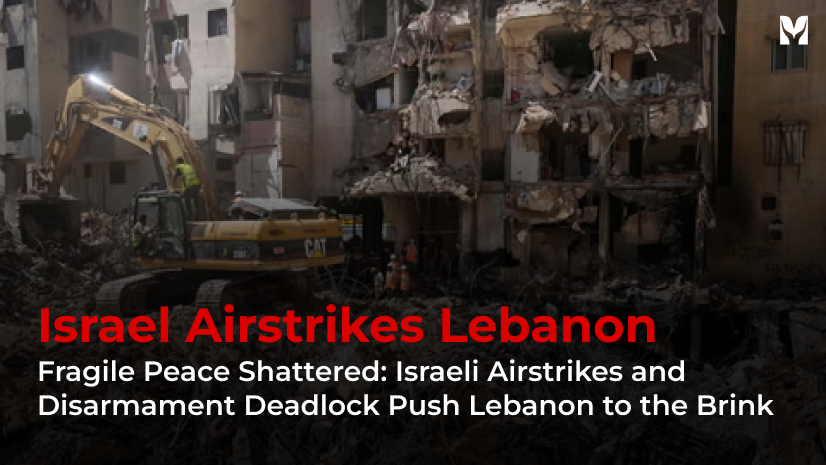
Fragile Peace Shattered: Israeli Airstrikes and Disarmament Deadlock Push Lebanon to the Brink
BEIRUT / JERUSALEM – A wave of intensive Israeli airstrikes across Lebanon has left the 2024 ceasefire agreement in tatters this week. As the Israeli Defense Forces (IDF) target smuggling routes and high-level operatives, a deepening political rift over the disarmament of Hezbollah suggests that the "simmering conflict" is rapidly returning to a boil.
The "Hermel Blitz" and Targeted Strikes
On Wednesday, January 21, the Israeli Air Force launched a coordinated offensive against four border crossings in the northeastern Hermel region, bordering Syria. The IDF stated the strikes were surgical operations aimed at cutting off Hezbollah’s "oxygen line"—the illicit transfer of Iranian-made weaponry through front companies.
Simultaneously, drone strikes in southern Lebanon targeted moving vehicles. One strike on the Zahrani-Msayleh road and another near Bazouriyeh resulted in at least two fatalities. Among the dead, Israel identified Mohammad Awatsheh, described as a "master smuggler" responsible for coordinating weapons shipments from Iraq through Syria.
Journalists and Civilians Caught in the Crossfire
The escalation reached a grim peak in the village of Qanariit, near Sidon. An Israeli airstrike reportedly injured 19 people, including several journalists and children. Lebanese media outlets released footage of smoke billowing over civilian infrastructure, prompting President Joseph Aoun to condemn the actions as a "systematic policy of aggression" designed to terrorize the Lebanese population.
The Litani River Deadlock: Disarmament vs. Containment
The military escalation coincides with a collapse in diplomatic trust over the implementation of the ceasefire’s core tenet: the removal of non-state weapons.
- The Lebanese Claim: On January 8, the Lebanese Armed Forces (LAF) declared the "first phase" of disarmament complete, asserting total control south of the Litani River.
- The Israeli Rebuttal: Israeli Foreign Minister Gideon Sa'ar dismissed the claim as "far from sufficient," alleging that Hezbollah's underground infrastructure and tunnel networks remain largely intact.
- The "Containment" Shift: Lebanese officials have recently pivoted, suggesting that while the South will be a "state-only weapons zone," the area North of the Litani will move toward a policy of "containment" rather than active disarmament—a move Israel views as a red line.
UNIFIL Under Threat
The United Nations Interim Force in Lebanon (UNIFIL) has reported increasingly dangerous encounters. On January 12, peacekeepers observed Israeli Merkava tanks moving into Lebanese territory. When requested to stop, one tank fired shells within 150 meters of the UN position, and peacekeepers reported being "continuously tracked by lasers" as they retreated.
ith UNIFIL's mandate set to conclude in December 2026, the current instability raises questions about whether the Lebanese Army is truly prepared to fill the security vacuum.
A Tense Outlook
As the Monitoring Committee—comprising the US, France, Israel, and Lebanon—convenes to save the truce, the reality on the ground tells a different story. With Hezbollah leader Naim Qassem declaring their arsenal a "red line" and Israel doubling down on preemptive strikes, the prospect of a sustained peace in 2026 remains more elusive than ever.
"The decisions we make today will shape the world for generations to come."