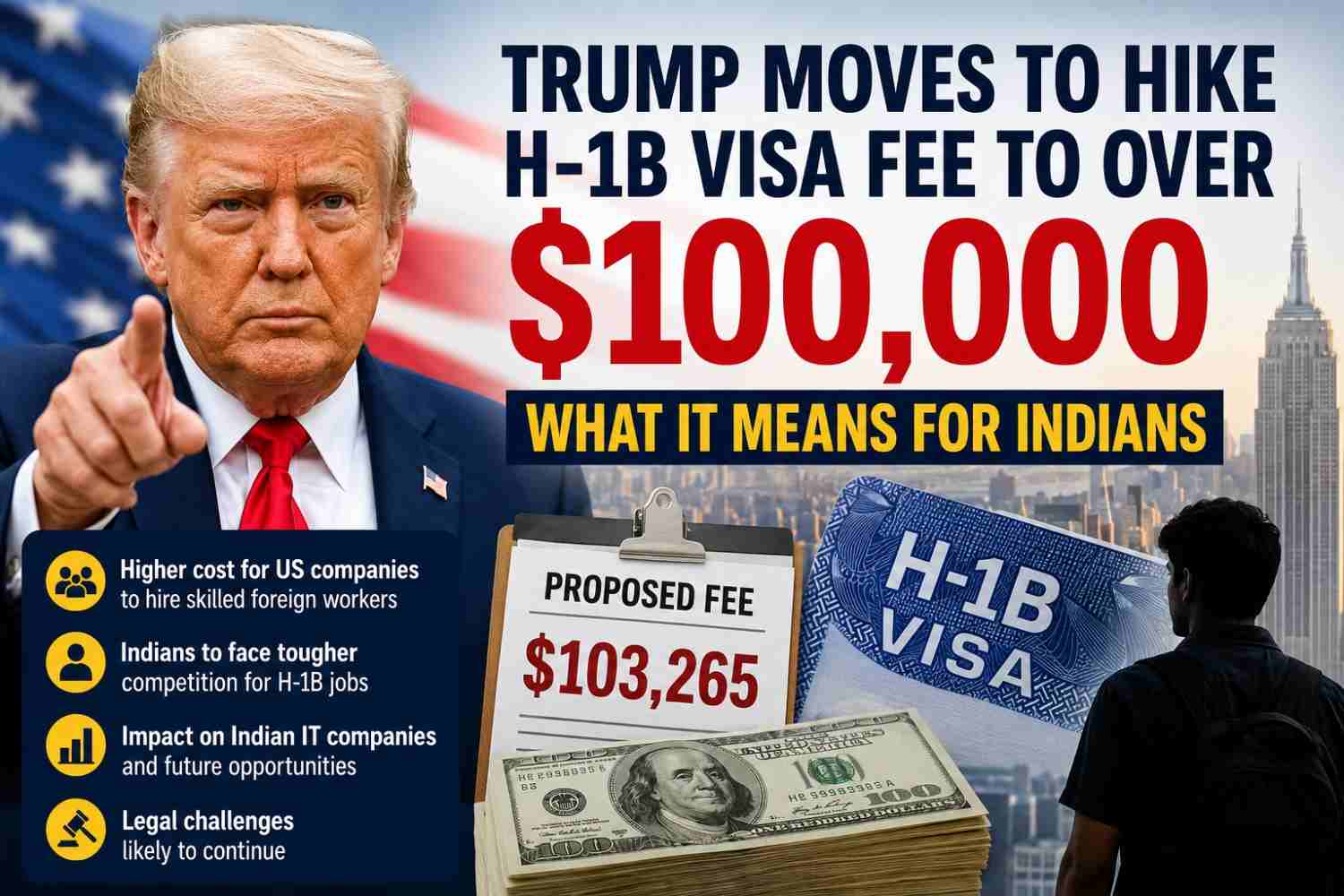
The Donald Trump administration has proposed a sharp increase in the H-1B visa fee, taking the cost to $103,265 for certain new H-1B petitions. The proposal, announced by the US Department of Homeland Security (DHS), seeks to make the six-figure charge a permanent part of the H-1B system.
The proposed fee would apply to cap-subject H-1B petitions, including those eligible for the US master's-degree exemption. It would be charged in addition to other applicable immigration fees. DHS estimates the measure could generate around $8.8 billion annually, based on an estimated 85,000 cap-subject petitions.
Why Indians Could Be Hit Hard
The H-1B programme is particularly important for Indian technology professionals, who make up a large share of beneficiaries. A fee of more than $100,000 could make it considerably more expensive for US companies to sponsor foreign workers.
For Indian IT professionals seeking opportunities in the US, the biggest impact may come indirectly. Employers could become more selective about sponsoring H-1B candidates, potentially making competition for jobs tougher and encouraging companies to hire locally or shift certain roles to other countries.
What About Existing H-1B Holders?
The proposed additional fee is focused on cap-subject petitions and does not generally apply to H-1B petitions that are exempt from the annual cap. Certain universities, government research organisations and nonprofit research institutions are among the categories that can qualify for exemptions.
The measure is therefore not simply a blanket $103,265 charge for every Indian currently working in America on an H-1B visa. Its exact impact will depend on the type of petition and the worker's circumstances.
Legal Battle Could Continue
The proposal follows a major legal setback for the Trump administration. A federal judge struck down the earlier $100,000 H-1B fee in June 2026, ruling that the administration had exceeded its authority.
The new proposal follows the formal regulatory process, including a public-comment period, meaning the measure is not yet final. Further legal challenges are also possible.
Impact on Indian IT Companies
Indian IT companies with significant US operations could face higher costs if they need to sponsor new H-1B workers under the proposed rules. Companies may respond by increasing hiring in India, expanding offshore delivery centres or reducing reliance on H-1B-dependent staffing models.
For Indian professionals, this could mean fewer US-based opportunities in some sectors, particularly if employers decide that the additional cost outweighs the benefits of sponsoring foreign talent.
What Happens Next?
The DHS proposal will go through the regulatory process before any permanent fee can take effect. Until the rule is finalised and its legal status is settled, Indian professionals and employers should not assume that the $103,265 charge is already permanently in force.
The proposed move nevertheless signals a significant tightening of US immigration policy and could reshape how American companies recruit highly skilled foreign workers, particularly from India.
"The decisions we make today will shape the world for generations to come."